




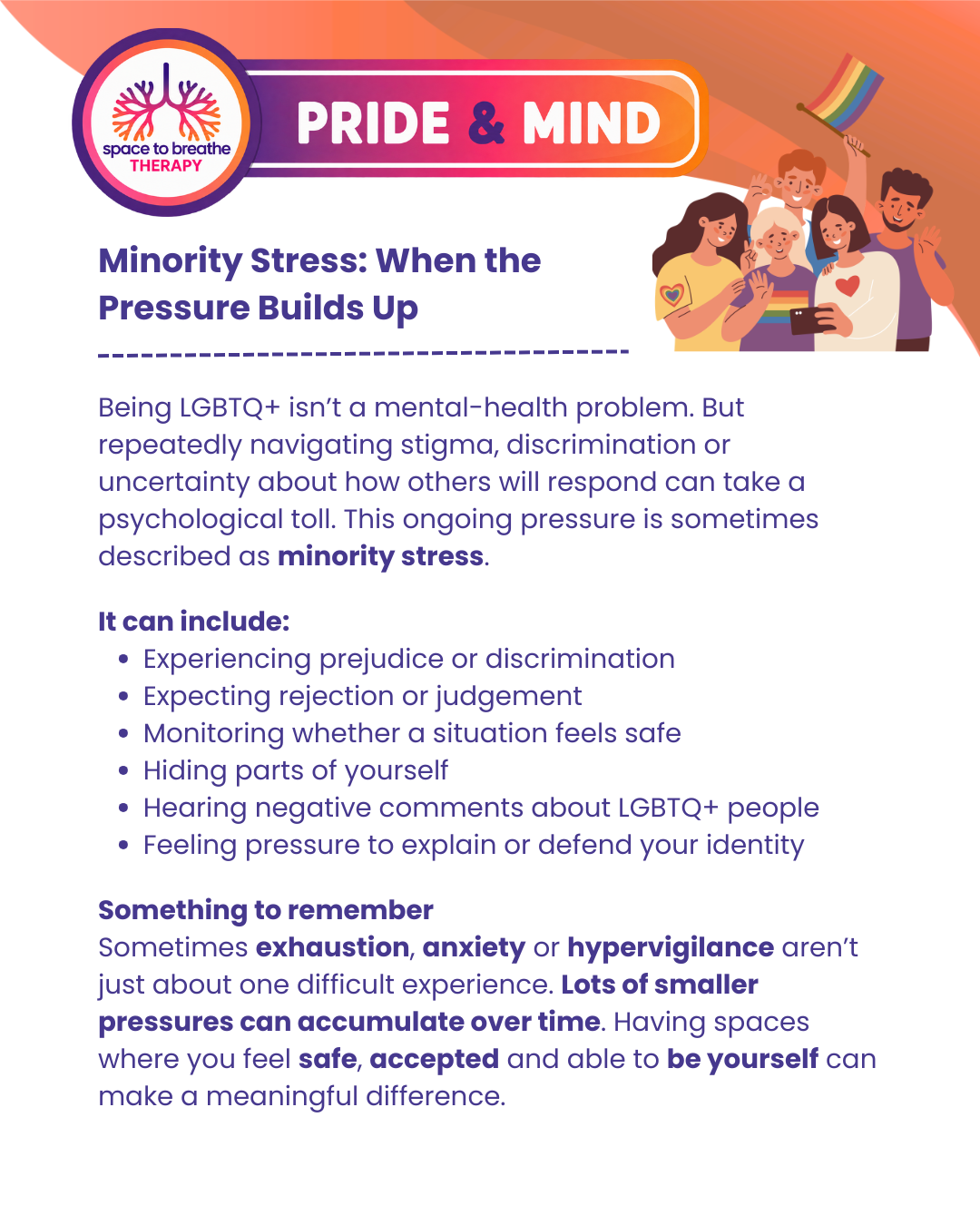
Minority Stress: When the Pressure Builds Up
Being LGBTQ+ is not a mental health problem. But living in a world where you may experience prejudice, discrimination, rejection or uncertainty about how other people will respond to you can create additional emotional pressure.
When these experiences happen repeatedly, the impact can build over time. This is often described as minority stress.
It isn't always one big event
Minority stress isn't only about obvious discrimination. Sometimes it is the accumulation of many smaller experiences.
It might be wondering whether it's safe to mention your partner at work.
Thinking carefully before holding someone's hand in public.
Hearing a negative comment and deciding whether to challenge it.
Having to explain your identity repeatedly.
Changing the way you speak, dress or behave because you're unsure how someone will react.
Or simply walking into a new environment and automatically assessing:
“Is it safe for me to be myself here?”
Doing this again and again can be exhausting.
How might minority stress affect you?
Over time, you might notice:
- Feeling constantly alert or on guard
- Anxiety about how others perceive you
- Exhaustion from monitoring yourself
- Avoiding certain people, places or situations
- Hiding parts of your identity
- Difficulty relaxing
- Feeling angry, frustrated or emotionally drained
- Becoming sensitive to possible rejection
- Feeling pressure to justify or defend yourself
- Struggling with confidence or belonging
These responses don't mean there is something wrong with your identity. They may reflect the pressure you've been navigating around it.
Creating spaces where you can put the armour down
Having somewhere you don't have to constantly monitor yourself can make a real difference.
That might be a trusted friend, partner, chosen family, therapist, support group, workplace network or LGBTQ+ community.
You deserve relationships where you don't have to repeatedly explain or defend who you are.
A little tip from me
If you're feeling exhausted and can't quite understand why, ask yourself:
“How much energy am I using trying to feel safe, accepted or understood?”
Sometimes we only count the obvious stresses in our lives and overlook the emotional energy involved in constantly assessing other people's reactions.
Recognising that pressure can help you understand why you may need more rest, stronger boundaries or additional support.
A message from me
If you've spent a long time adapting yourself to different environments, you may have become incredibly good at it.
But being good at coping doesn't mean it isn't tiring.
You deserve places where your shoulders can drop.
Where you don't have to check every word.
Where you aren't preparing yourself for somebody else's reaction.
Where you can simply be a person rather than constantly explaining your identity.
Finding those spaces may take time, but they matter.
Your identity isn't the problem. The pressure of having to protect it can be.
Until next time, give yourself space to breathe.
With love, Maggie
Space to Breathe Therapy