





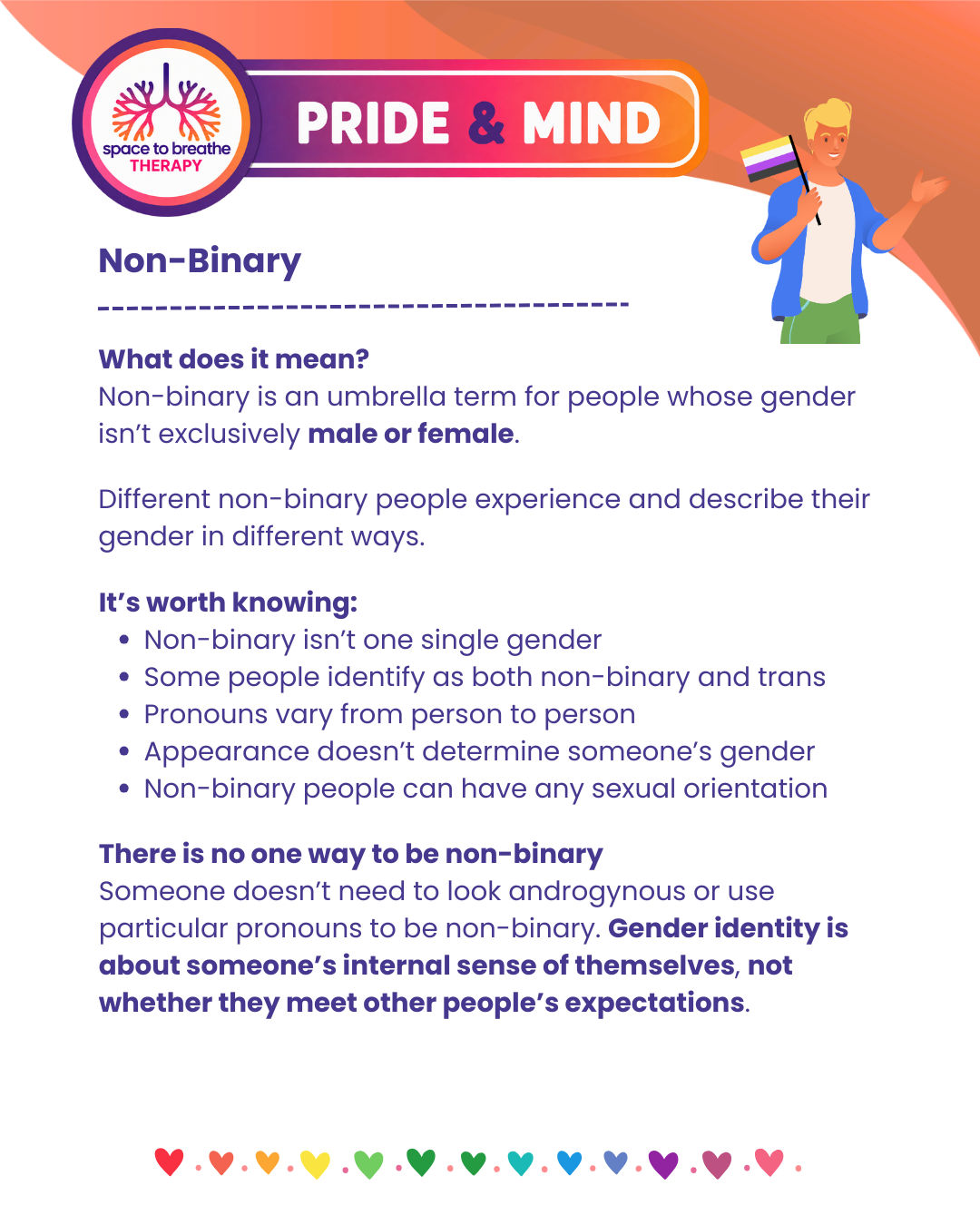
Non-Binary – There Is No One Way to Be You
Many of us grow up hearing gender described as two possibilities: male or female. For some people, however, neither of those categories fully describes their internal experience.
Non-binary is an umbrella term used by people whose gender isn't exclusively male or female.
That doesn't mean every non-binary person experiences gender in the same way. Non-binary can include many different identities and experiences, and for some people, simply non-binary is the word that feels right.
What can being non-binary feel like?
There isn't one answer.
Someone may feel partly male and partly female. They might experience themselves as somewhere between genders, outside those categories altogether, as having more than one gender, or as having little or no sense of gender.
For some people their experience remains fairly consistent. For others it may change over time.
The important thing to remember is that non-binary isn't a third box that everyone outside male or female has to squeeze into.
It describes a broad and diverse range of experiences.
Non-binary and transgender
Some non-binary people also identify as transgender because their gender differs from the sex they were assigned at birth.
Others don't use the word trans for themselves.
Neither choice makes someone's non-binary identity more or less valid.
As with all identity language, the individual gets to decide which words feel right for them.
You can't tell by looking at someone
There is sometimes an assumption that a non-binary person should look androgynous.
They don't have to.
A non-binary person might love traditionally feminine clothes, have a beard, wear make-up, dress very masculinely, mix different styles or not think very much about gender expression at all.
Gender expression is not the same as gender identity.
How somebody looks doesn't tell you who they are.
What about pronouns?
Many non-binary people use they/them, but not everyone does.
Someone might use she/her, he/him, they/them, a combination of pronouns or other pronouns.
Rather than assuming someone's pronouns because they tell you they're non-binary, listen to the language they use.
If you're unsure and it's appropriate to ask, a simple “What pronouns do you use?” is enough.
Non-binary doesn't describe sexuality
Being non-binary tells you about someone's gender, not who they're attracted to.
Non-binary people can have any sexual orientation and can be in any kind of relationship.
Gender identity, gender expression and sexual orientation are connected parts of some people's lives, but they don't mean the same thing.
If someone tells you they're non-binary
You don't need to respond with lots of questions.
You don't need to understand everything immediately.
And you don't need to decide whether their identity makes sense to you.
Listen.
Respect their name and pronouns.
Don't share their identity with other people unless they've said that's okay.
And try not to treat them as though they've suddenly become a completely different person.
They may simply be sharing something about themselves that you didn't know before.
If you're wondering whether you might be non-binary
You don't need to rush towards an answer.
Perhaps you've always felt uncomfortable being described exclusively as a man or woman.
Perhaps you've only recently started questioning gender.
Or perhaps you've found a word that suddenly makes experiences from years ago make more sense.
You are allowed to explore privately.
You can try different language.
You can change your mind.
You can decide that non-binary fits you, or discover that another word feels more accurate.
Understanding yourself isn't an exam with one correct answer.
A message from me
Sometimes labels are misunderstood as things that restrict us.
But for many people, finding the right word can actually do the opposite.
It can bring relief: “There are other people who experience this too.”
If non-binary is a word that helps you understand yourself, you don't have to look a particular way or convince anybody that you qualify.
And if someone you care about tells you they're non-binary, remember that you don't need to become an expert overnight.
Be curious without being intrusive. Listen to what they tell you. Respect the language they use.
Most importantly, continue seeing the whole person in front of you.
There is no one way to be non-binary. There is simply room for people to be themselves.
Until next time, give yourself space to breathe.
With love,
Maggie




