





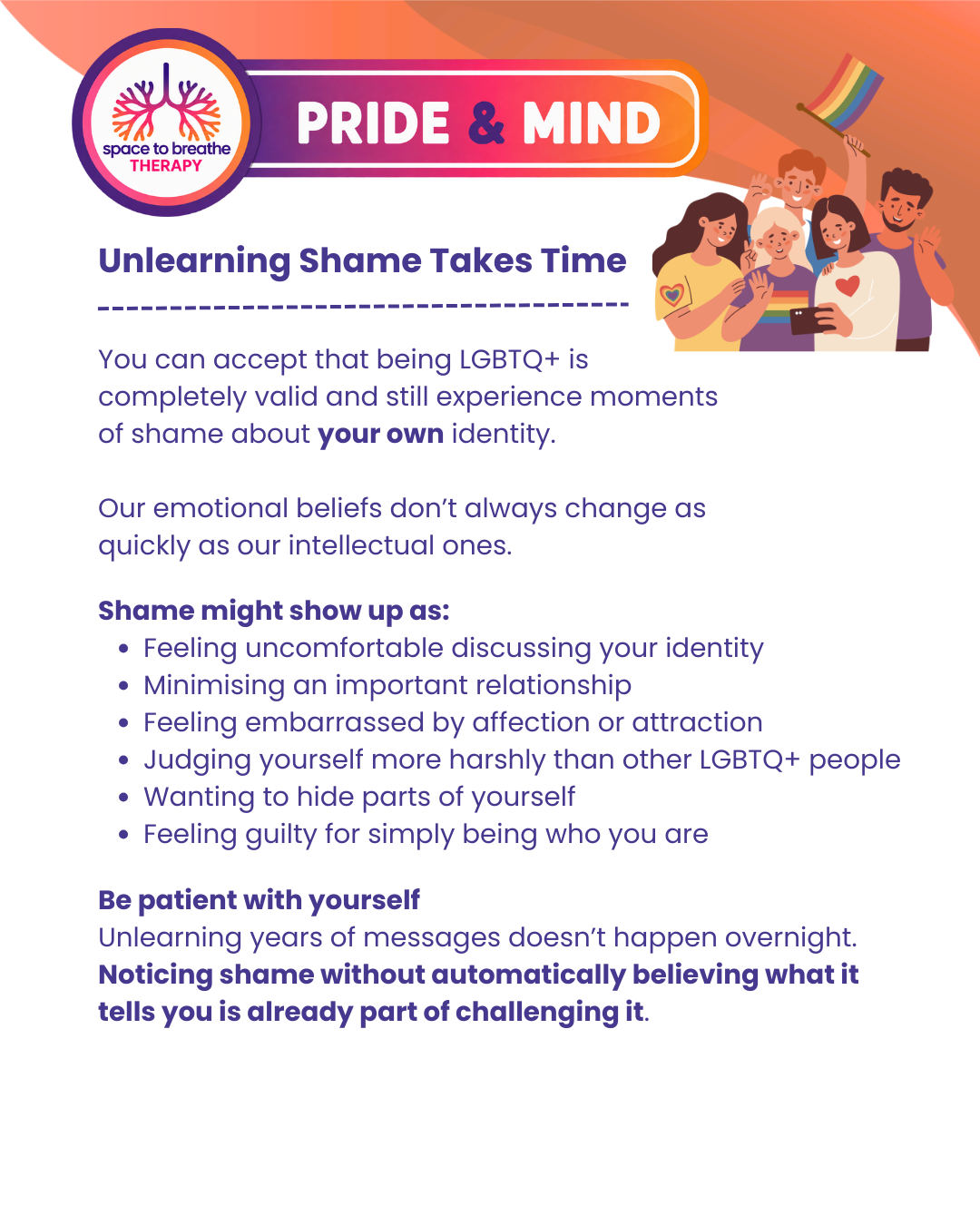
Unlearning Shame Takes Time
Shame can be one of the quieter and more difficult parts of understanding and accepting your LGBTQ+ identity.
You may intellectually know that there is absolutely nothing wrong with who you are, who you love or how you identify — yet still notice uncomfortable feelings appearing.
That doesn't necessarily mean you don't accept yourself.
Sometimes it means you are unlearning messages that have been around for a very long time.
Where can shame come from?
Long before we understand our own identity, we absorb messages about what relationships, gender, sexuality and families are supposedly meant to look like.
Those messages can come from family, school, religion, culture, workplaces, friendships, television, social media or simply from hearing the way other people talk about LGBTQ+ people.
Even when we consciously reject those messages later, their emotional impact can sometimes remain.
This is why you might genuinely believe:
“There is nothing wrong with being LGBTQ+.”
Yet find yourself thinking:
“But why do I feel uncomfortable when it's about me?”
Both experiences can exist at the same time.
Shame doesn't always look like shame
Sometimes it is obvious. At other times it hides behind thoughts and behaviours that are harder to recognise.
You might minimise a relationship when talking to other people, avoid correcting someone who makes assumptions about you, feel uncomfortable showing affection, compare yourself with other LGBTQ+ people or become unusually critical of yourself.
You might even notice that you are completely accepting of somebody else's identity while holding yourself to a very different standard.
When this happens, it can be useful to ask:
“Would I speak to another LGBTQ+ person the way I'm speaking to myself right now?”
If the answer is no, that may be something worth gently exploring.
Unlearning takes practice
You don't have to fight every uncomfortable thought or force yourself to immediately replace it with confidence.
Start by noticing.
There's that feeling again.
Where did I learn that?
Is this actually what I believe today?
Whose voice does this sound like?
What would I rather believe about myself?
Creating even a small gap between having a thought and believing that thought can be powerful.
Over time, the messages you consciously choose for yourself can become louder than the ones you inherited from other people.
A message from me
Please be patient with yourself while you're doing this.
If you've spent years receiving messages that encouraged you to hide, question or minimise parts of yourself, it is understandable that those messages may not disappear the moment you decide you no longer agree with them.
You don't have to feel completely fearless to be making progress.
Sometimes progress is noticing the shame.
Sometimes it's questioning it.
Sometimes it's choosing not to let it make the decision.
And sometimes it's simply saying:
“I don't want to speak to myself like that anymore.”
That is part of unlearning too.
You deserve the opportunity to discover who you are underneath all the expectations, judgements and rules that may never have belonged to you in the first place.
There is no deadline for becoming comfortable with yourself. Take your time.
Until next time, give yourself space to breathe.
With love,
Maggie




