





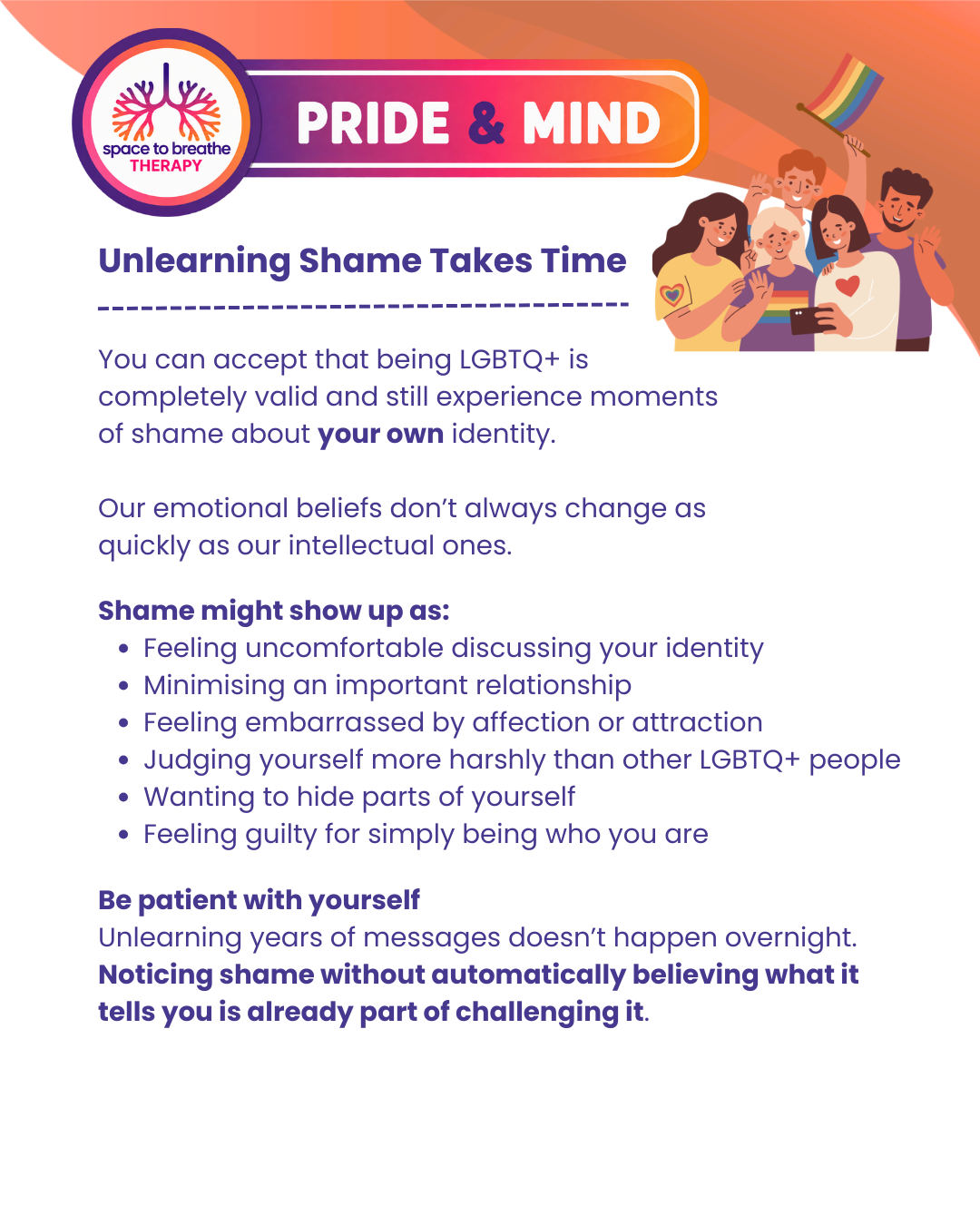
Unlearning Shame Takes Time
You can know that being LGBTQ+ is completely valid and still experience moments of shame about your own identity.
That can be confusing.
You might think, “I don't judge anybody else for being LGBTQ+, so why am I judging myself?”
The answer can sometimes be found in the messages and experiences we've carried with us for years.
Our intellectual beliefs can change relatively quickly. Our emotional responses often take longer to catch up.
Shame can be learned
Shame doesn't necessarily begin with something we personally believe.
It can develop through repeated experiences — hearing negative comments, witnessing discrimination, being told certain relationships are wrong, seeing LGBTQ+ people mocked, noticing uncomfortable reactions or simply growing up in an environment where being LGBTQ+ was never openly discussed.
Sometimes nobody directly says, “You should be ashamed.”
The message is communicated in much quieter ways.
You learn what is celebrated.
You notice what is hidden.
You see what people laugh at.
You recognise what makes other people uncomfortable.
And gradually, you may learn that certain parts of yourself are safer kept out of sight.
What can shame look like?
Shame isn't always an obvious feeling of embarrassment.
It might appear as:
- Struggling to say the words you use to describe your identity
- Feeling uncomfortable discussing your partner
- Pulling away from affection in public
- Feeling guilty after expressing yourself authentically
- Comparing yourself with other LGBTQ+ people
- Worrying that you're "too much" or "not enough"
- Feeling uncomfortable receiving acceptance or support
- Being kinder about somebody else's identity than you are about your own
Sometimes it appears as a thought:
“I wish I wasn't like this.”
Rather than immediately criticising yourself for having that thought, become curious about it.
Where did it come from?
You are not required to believe every thought
One of the most useful things we can learn is that having a thought doesn't automatically make it true.
A shame-based thought might be familiar because you've repeated it hundreds of times — not because it accurately reflects who you are.
When one appears, try creating a little space around it:
“I notice I'm feeling ashamed right now.”
Then perhaps ask:
“What has triggered this?”
“Is this what I believe today, or something I learned to believe?”
“Would I want someone else to feel ashamed for this?”
You don't have to immediately replace the thought with something wonderfully positive.
Sometimes simply recognising “I don't have to automatically believe this anymore” is enough.
Unlearning isn't a straight line
There may be days when you feel comfortable, confident and proud.
Then something happens — a comment, family conversation, social situation, relationship difficulty or memory — and those old feelings return.
That doesn't erase your progress.
Healing and self-acceptance rarely happen in a perfectly straight line.
Sometimes returning to an old feeling simply gives you another opportunity to respond to it differently.
A message from me
Please don't turn the process of overcoming shame into another reason to criticise yourself.
You don't need to think:
“I should be over this by now.”
There is no deadline.
If these messages took years to develop, give yourself permission to take time to challenge them.
Notice the shame.
Question it.
Be curious about where it came from.
And gradually begin deciding which beliefs still deserve a place in your life.
You are allowed to outgrow the messages that once taught you to hide.
And every time you notice shame without automatically accepting what it tells you, you're already beginning to loosen its hold.
Until next time, give yourself space to breathe.
With love,
Maggie