





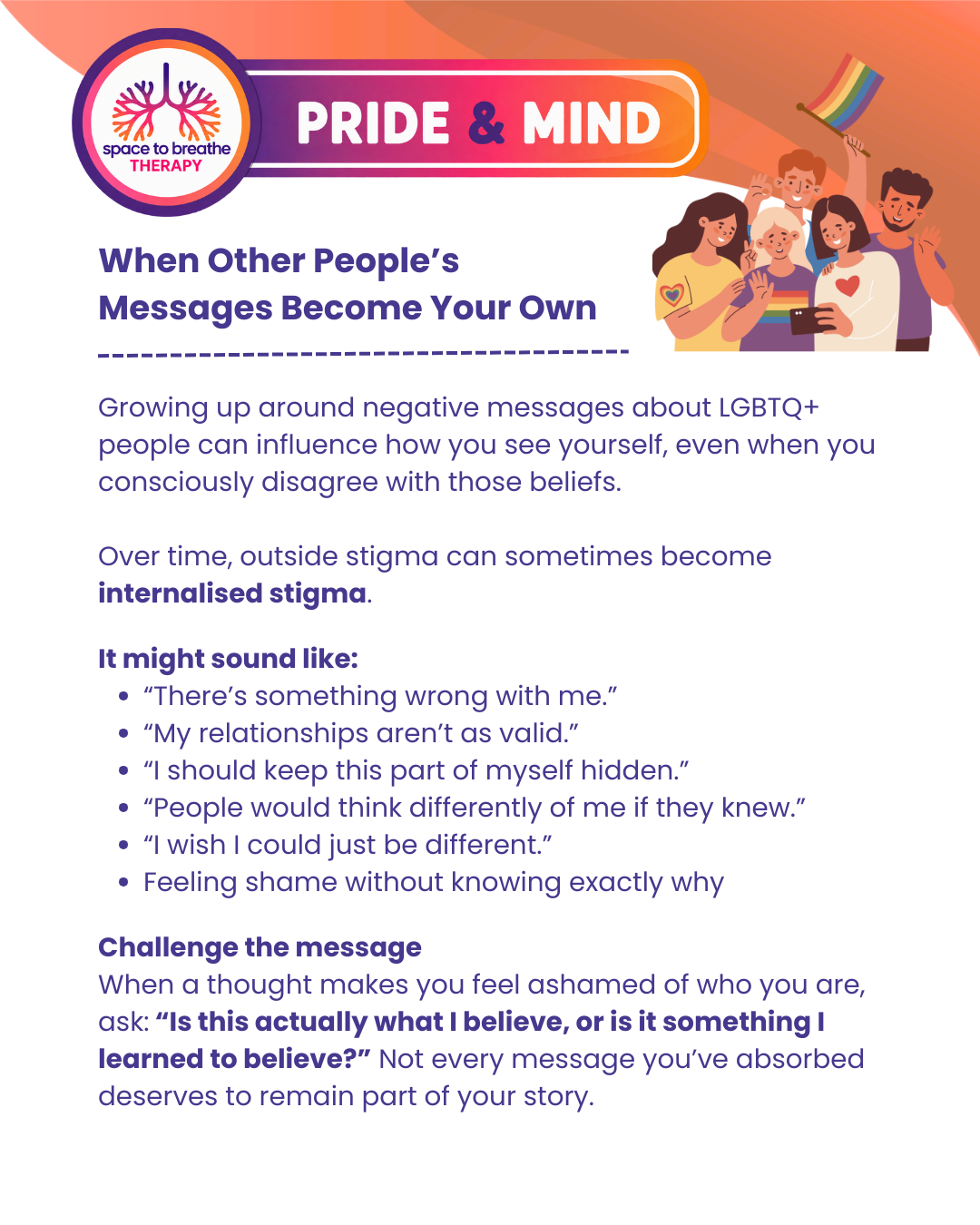
When Other People’s Messages Become Your Own
Sometimes the things we believe about ourselves didn't actually begin with us.
From a very young age, we absorb messages about what is considered "normal", acceptable or expected. We hear conversations around us, notice people's reactions, see which relationships are represented positively and recognise when certain identities are mocked, criticised or simply never mentioned.
For an LGBTQ+ person, these experiences can quietly influence the way you eventually see yourself.
Even when your adult mind completely rejects those beliefs, the emotional messages you absorbed earlier can sometimes remain.
This is often described as internalised stigma.
When outside judgement becomes an inside voice
Internalised stigma can happen when negative attitudes that exist around us gradually become thoughts we direct towards ourselves.
Perhaps you grew up hearing comments about LGBTQ+ people.
Maybe being heterosexual or cisgender was simply assumed to be the only possibility.
Perhaps you heard jokes, witnessed bullying or learned that certain identities should be hidden.
You may not have agreed with those messages — but hearing them repeatedly can still leave an imprint.
Then, when you begin recognising your own identity, those old messages can suddenly feel very personal.
Instead of hearing:
"People like that shouldn't..."
the thought can become:
"Maybe I shouldn't..."
That's an important difference to recognise.
Whose voice is this?
One useful way of challenging internalised stigma is to become curious about where a thought came from.
When you notice yourself thinking:
"There's something wrong with me."
"I shouldn't tell anyone."
"My relationship isn't as important."
"People will judge me."
try asking yourself:
"Is this actually what I believe?"
Then go a little further:
"Where might I have learned this?"
It could be a parent's opinion, something you heard at school, a religious or cultural message, an old friendship, a previous relationship, social media or simply years of living in an environment where LGBTQ+ identities weren't spoken about positively.
Understanding where a message came from can help you recognise that you don't have to keep carrying it.
Start creating your own messages
Challenging old beliefs doesn't mean forcing yourself to think positively all the time.
It can begin with something much simpler.
Instead of:
"There's something wrong with me."
you might practise:
"I'm learning that this feeling came from messages I was given, not from something being wrong with me."
Instead of:
"I should hide this."
you might think:
"I get to decide what I share, when I share it and who I feel safe sharing it with."
Instead of:
"My relationship isn't as valid."
you might remind yourself:
"My relationship deserves the same respect, care and value as anyone else's."
These new messages may feel unfamiliar at first. That's okay. You're building a different relationship with yourself.
A message from me
Sometimes we carry other people's words for so long that we stop recognising them as somebody else's.
So when that critical voice appears, try not to immediately accept everything it tells you.
Pause and become curious.
Who taught me this?
Do I still agree with it?
Would I want someone I care about to believe this about themselves?
And perhaps most importantly:
What would I like to believe instead?
You are allowed to question the messages you inherited.
You are allowed to leave some of them behind.
And you are allowed to write something different for yourself.
Not every message you've absorbed deserves to remain part of your story.
Until next time, give yourself space to breathe.
With love,
Maggie




