





Self-Worth Beyond Performance
Understanding Your Value Beyond Achievements, Productivity and Expectations
In a world that often measures success through achievements, productivity, qualifications, employment and visible accomplishments, it can become easy to believe that our worth depends on what we achieve.
You may feel proud of yourself when you complete a task, receive praise, meet a deadline or achieve something important.
However, when things do not go as planned, you might experience disappointment, guilt, shame or a sense that you are not good enough.
You may find yourself thinking:
- “I should be doing more.”
- “If I'm not productive, I'm wasting time.”
- “I only feel good about myself when I achieve something.”
- “Everyone else seems to manage more than I do.”
- “If I make a mistake, I've failed.”
- “I need to prove that I'm capable.”
- “If I cannot work or contribute, what value do I have?”
These thoughts can become particularly difficult during periods of illness, disability, burnout, unemployment, emotional distress or significant life changes.
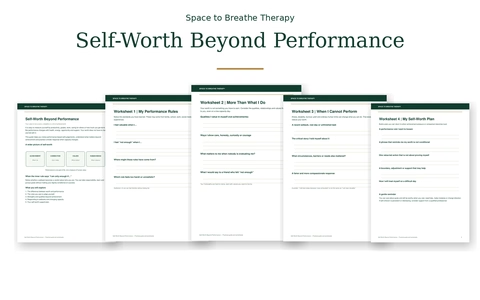
Self-Worth Beyond Performance is a practical five-page guide and worksheet resource designed to help you explore the relationship between achievement and self-esteem, recognise performance-based beliefs and develop a more compassionate understanding of your personal value.
Rather than encouraging you to abandon goals or stop recognising achievements, this resource helps you separate what you do from who you are.
The aim is to develop a sense of self-worth that remains meaningful even when your energy, circumstances, abilities or achievements change.
Understanding Self-Worth and Performance
Self-worth refers to the value and respect we recognise in ourselves as individuals.
Performance relates to what we do, produce, accomplish or achieve.
Although achievements can contribute to confidence and satisfaction, they do not determine our entire value as human beings.
For example, you may feel pleased when you complete a project or receive positive feedback.
However, if your self-worth depends entirely on those experiences, setbacks may feel like evidence that you are inadequate rather than ordinary parts of life.
A performance-based sense of worth may lead to patterns such as:
- Constantly trying to achieve more.
- Feeling guilty when resting.
- Comparing yourself with others.
- Struggling to accept mistakes.
- Finding it difficult to ask for help.
- Feeling uncomfortable when you are not busy.
- Measuring your value through productivity.
- Believing that achievements determine whether you deserve respect.
The resource introduces a visual self-worth diagram to explore how personal value extends beyond achievements.
Your worth can include your individuality, relationships, values, experiences, personal qualities and the simple fact that you are a person deserving of dignity and respect.
When Achievement Becomes a Measure of Personal Value
Achievement can be meaningful and motivating.
Setting goals, developing skills and recognising progress can support confidence and wellbeing.
However, difficulties may arise when achievement becomes the primary condition for feeling acceptable.
For example:
Achievement-based belief: “I am only worthwhile when I am successful.”
Possible emotional response: Anxiety, pressure or fear of failure.
Possible behaviour: Overworking, perfectionism or avoiding challenges that might expose mistakes.
Longer-term impact: Exhaustion, self-criticism and difficulty recognising personal value outside performance.
This pattern can become self-reinforcing.
Even when you achieve something, the sense of satisfaction may be temporary before another expectation appears.
You may feel that you must continually prove yourself.
Recognising this pattern can help you begin questioning whether your expectations are realistic, fair or supportive.
Worksheet 1 – My Performance Rules
The first practical worksheet encourages you to explore the expectations and beliefs that influence your sense of self-worth.
These may be rules you have consciously adopted or assumptions that developed through previous experiences.
You can reflect on:
- What makes me feel successful?
- When do I feel proud of myself?
- What happens emotionally when I cannot achieve something?
- Do I feel guilty when resting?
- Do I compare my productivity with other people's?
- What do I believe I must achieve to feel good enough?
- Where might these expectations have come from?
For example:
Performance rule: “I must always be productive.”
Possible origin: Growing up in an environment where being busy was strongly valued.
Emotional impact: Guilt when resting and pressure to keep working.
Alternative perspective: “Rest is a legitimate need. My value does not disappear when I am not producing something.”
The worksheet encourages you to recognise how these internal rules may affect your wellbeing.
Worksheet 2 – More Than What I Do
The second worksheet encourages you to explore your identity beyond achievements, job titles and responsibilities.
You are more than your qualifications, income, productivity or ability to complete tasks.
You may have personal qualities that remain meaningful regardless of what you accomplish.
These might include:
- Kindness.
- Curiosity.
- Creativity.
- Humour.
- Compassion.
- Honesty.
- Thoughtfulness.
- Determination.
- Sensitivity.
- Loyalty.
- Individual interests.
- Personal values.
The worksheet invites you to reflect on:
- Qualities I value in myself.
- Things that matter to me.
- Ways I express care or connection.
- Interests that bring meaning to my life.
- Strengths that are not measured through productivity.
- What I would want someone to recognise about me beyond my achievements.
For example, you might recognise that being a thoughtful friend, enjoying creativity or showing compassion are meaningful parts of who you are.
These qualities do not need to produce a measurable outcome to have value.
Worksheet 3 – When I Cannot Perform
There are times in life when our ability to achieve, work or manage responsibilities changes.
Illness, disability, emotional distress, bereavement, burnout, caring responsibilities or unexpected circumstances may affect what we are able to do.
For someone whose self-worth is closely connected to productivity, these changes can feel particularly difficult.
You may experience:
- Guilt about resting.
- Frustration about reduced capacity.
- Fear of disappointing others.
- Shame about needing support.
- A sense of lost identity.
- Pressure to return to previous levels of functioning.
- Comparisons with what you used to manage.
The third worksheet encourages you to explore these experiences with greater compassion.
You can reflect on:
- How do I speak to myself when my capacity is reduced?
- What expectations become difficult during these periods?
- Do I judge myself differently when I need help?
- What would I say to someone else experiencing the same difficulties?
- What support or adjustments might help?
- How can I recognise my worth when I cannot perform as expected?
For example:
Self-critical thought: “I'm useless because I cannot manage what I used to.”
Compassionate alternative: “My circumstances and capacity have changed. This does not reduce my worth or my right to support.”
The aim is to recognise that fluctuating capacity is not a measure of personal value.
Worksheet 4 – My Self-Worth Plan
The final worksheet brings together your reflections into a personalised plan for developing a more stable and compassionate sense of self-worth.
You can identify:
- Performance-based beliefs you want to question.
- Personal qualities you value.
- Situations that trigger self-criticism.
- Supportive reminders.
- Ways to respond to setbacks.
- Boundaries that protect your wellbeing.
- Activities that provide meaning beyond achievement.
- People who support you without placing conditions on your worth.
For example:
Old belief: “I only deserve rest when everything is finished.”
Balanced perspective: “Rest is a basic need, not a reward for productivity.”
Supportive action: Allow regular breaks without requiring myself to complete every task first.
The plan encourages manageable changes rather than creating another set of expectations you must achieve perfectly.
Self-Worth, Perfectionism and Fear of Failure
Perfectionism can sometimes develop when people feel that mistakes threaten their value or acceptance.
You may believe that doing something well is not enough unless it is done perfectly.
This can lead to:
- Excessive checking.
- Difficulty finishing tasks.
- Fear of criticism.
- Avoiding unfamiliar challenges.
- Setting unrealistic standards.
- Feeling dissatisfied despite achievements.
- Harsh self-judgement following mistakes.
A more balanced approach recognises that mistakes and limitations are part of being human.
For example:
Performance-based thought: “If I make a mistake, I am a failure.”
Balanced perspective: “I made a mistake, but that does not define me. I can learn, make adjustments and continue.”
The aim is not to lower your aspirations but to separate your goals from your personal worth.
Self-Worth, Rest and Productivity
Many people struggle to rest without feeling guilty.
Rest may be viewed as something that must be earned after completing responsibilities.
However, rest is an important part of physical and emotional wellbeing.
You do not need to reach exhaustion before recognising that you need a break.
You do not need to prove that you have worked hard enough to deserve recovery.
And you do not need to justify every moment that is not productive.
Developing self-worth beyond performance can help you recognise that rest, enjoyment, connection and personal wellbeing are meaningful parts of life.
A day without visible achievements is not necessarily a wasted day.
Self-Worth, Disability and Neurodivergence
For disabled and neurodivergent individuals, performance-based expectations can create additional emotional pressure.
Autistic people, individuals with ADHD and those living with chronic health conditions may experience differences in executive functioning, sensory processing, energy, concentration or communication.
Some individuals may have spent years trying to meet expectations that did not account for their needs.
This can contribute to internal beliefs such as:
- “I should be able to do what everyone else does.”
- “If I need adjustments, I'm not capable.”
- “I must work harder to prove myself.”
- “I am failing because ordinary tasks are difficult.”
- “I should be able to manage without support.”
These beliefs can become particularly painful when capacity fluctuates.
The resource encourages you to recognise that needing support does not reduce your value.
Reasonable adjustments, accessible environments, rest and practical assistance are not signs of inadequacy.
They are ways of supporting individual needs.
Your worth is not determined by how closely you can match someone else's expectations, productivity or way of functioning.
Self-Worth During Life Changes
Changes in employment, relationships, health or personal circumstances can affect identity.
Someone who has always identified strongly with their career may experience a loss of confidence when they stop working.
A person who has been a caregiver may struggle to recognise their identity when responsibilities change.
Someone recovering from burnout may feel frustrated that they cannot function as they did previously.
These experiences can involve genuine grief, uncertainty and adjustment.
Developing self-worth beyond performance does not mean dismissing those feelings.
Instead, it encourages you to recognise that your identity can include many different aspects of life.
You remain a person of value even when familiar roles change.
What Is Included?
This downloadable five-page PDF contains:
Page 1 – Understanding Self-Worth Beyond Performance
An introduction to the difference between self-worth and achievement, including a visual diagram exploring the many aspects of personal value beyond productivity.
Page 2 – My Performance Rules
A reflective worksheet for identifying achievement-based expectations, internal rules and beliefs that influence self-esteem.
Page 3 – More Than What I Do
A practical worksheet for exploring personal qualities, values, interests and meaningful aspects of identity beyond achievements.
Page 4 – When I Cannot Perform
A guided reflection exercise for recognising self-critical responses during setbacks, reduced capacity or periods when productivity is difficult.
Page 5 – My Self-Worth Plan
A personalised plan for challenging performance-based beliefs, developing compassionate perspectives and identifying supportive actions.
The worksheets provide space for personal reflection and can be completed independently or alongside therapy and coaching.
Who Is This Resource For?
Self-Worth Beyond Performance may be helpful for adults who:
- Measure their value through achievements or productivity.
- Experience perfectionism.
- Feel guilty when resting.
- Struggle with self-criticism.
- Fear failure or disappointing others.
- Experience burnout or emotional exhaustion.
- Are adjusting to illness or disability.
- Experience fluctuating energy or capacity.
- Are navigating changes in employment or identity.
- Want to develop a more compassionate sense of self-worth.
The resource may also support therapeutic conversations about self-esteem, perfectionism, identity, disability, burnout, personal expectations and emotional wellbeing.
A Gentle Reminder
Your worth does not disappear when you make a mistake.
It does not decrease when you need rest.
It is not determined by your job title, qualifications, income, productivity or ability to meet other people's expectations.
You can value your achievements without allowing them to define your entire identity.
You can have ambitions while recognising your limits.
You can take pride in what you accomplish while also accepting yourself on the days when very little gets done.
You are more than what you produce, achieve or provide for others.
Your value is not something you have to continually earn.
You deserve dignity, compassion, connection and support regardless of how productive or successful you feel.
Learning to recognise this may take time, particularly if achievement has been closely connected to your sense of identity for many years.
The aim is not to stop caring about your goals.
It is to build a relationship with yourself in which your worth remains present even when performance changes.
Space to Breathe Therapy
This resource is intended for education, personal reflection and emotional wellbeing support. It does not replace individual psychological, medical or professional advice. If difficulties with self-worth, perfectionism, anxiety or low mood are persistent or significantly affecting daily life, consider seeking support from an appropriately qualified professional.




