





The Gremlin Process
Understanding Your Inner Critic, Challenging Negative Self-Talk and Developing a More Compassionate Inner Voice
We all have an internal voice that influences how we think about ourselves, interpret situations and respond to challenges.
Sometimes this voice is encouraging, supportive and reassuring.
At other times, it can become critical, demanding or discouraging.
You might find yourself thinking:
- “I'm not good enough.”
- “Everyone else can manage this, so why can't I?”
- “I'm going to get it wrong.”
- “People will judge me.”
- “I should be doing better.”
- “There's no point trying because I'll only fail.”
These thoughts can become so familiar that we barely notice them.
Over time, negative self-talk may affect confidence, emotional wellbeing, relationships and our willingness to try new experiences.
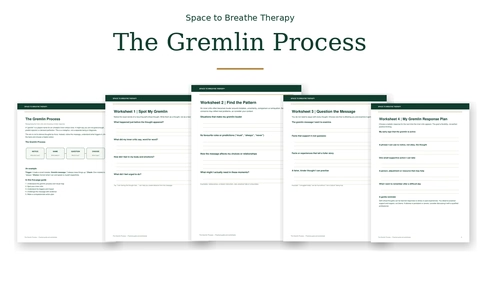
The Gremlin Process is a practical five-page guide and worksheet resource designed to help you recognise your inner critic, understand the patterns behind negative self-talk, question unhelpful messages and develop a more compassionate way of responding to yourself.
The term gremlin is used as a metaphor for the critical internal voice that can undermine confidence, exaggerate difficulties or encourage self-doubt.
The aim is not to eliminate every negative thought or pretend that difficulties do not exist.
Instead, the resource encourages you to recognise when your inner critic is influencing your thinking and learn how to respond with greater awareness, balance and self-compassion.
What Is the Gremlin Process?
The Gremlin Process explores how negative self-talk can become a repeating pattern.
A difficult situation may trigger a critical thought, which influences how we feel and behave.
Our response may then reinforce the original belief.
For example:
Situation: You make a mistake at work.
Gremlin message: “You're completely useless.”
Emotional response: Shame, anxiety or embarrassment.
Behaviour: Withdrawing, avoiding responsibility or repeatedly checking your work.
Possible outcome: Reduced confidence and increased fear of future mistakes.
The resource introduces a visual four-stage process to help you recognise how these patterns develop.
Trigger → Gremlin Message → Emotional Response → Behaviour
By identifying each stage, you can begin to explore where a different response might be possible.
Understanding Your Inner Critic
The inner critic is a term often used to describe self-critical thoughts and internal messages.
These messages may develop through a combination of experiences, expectations, beliefs and learned responses.
For some people, the inner critic becomes particularly noticeable during periods of stress, uncertainty or emotional vulnerability.
It may appear when you:
- Make a mistake.
- Receive criticism.
- Compare yourself with others.
- Try something unfamiliar.
- Feel rejected or misunderstood.
- Experience difficulty completing a task.
- Need to ask for help.
- Feel that you have disappointed someone.
The inner critic may sometimes appear to be trying to protect you.
For example, it might suggest that being extremely self-critical will prevent future mistakes.
However, harsh self-judgement can increase anxiety and reduce confidence rather than improve performance.
Recognising this distinction can help you develop more constructive ways of responding.
Worksheet 1 – Spot My Gremlin
The first practical worksheet encourages you to notice when your inner critic becomes active.
You can reflect on:
- Situations that trigger negative self-talk.
- The exact words your gremlin uses.
- How believable those messages feel.
- The emotions that follow.
- Physical sensations.
- How you respond to the criticism.
For example:
Situation: I struggled to complete a task.
Gremlin message: “You should be able to do this. Everyone else can.”
Emotion: Frustration, shame and anxiety.
Response: I became overwhelmed and stopped trying.
Writing down these messages can help you recognise them as thoughts rather than unquestionable facts.
You may also begin to notice that your gremlin uses similar language across different situations.
Worksheet 2 – Find the Pattern
Negative self-talk often follows recognisable patterns.
Your inner critic might become louder when you are tired, stressed, overwhelmed or facing unfamiliar demands.
The second worksheet encourages you to explore what influences your gremlin.
You may consider:
- When does my gremlin appear most often?
- What situations make it louder?
- Does it use particular words or phrases?
- Does it compare me with other people?
- Does it expect perfection?
- Does it focus on past mistakes?
- Does it become stronger when I am exhausted?
- How does it influence my behaviour?
For example, you may notice that your gremlin becomes particularly critical when you make mistakes in front of other people.
Alternatively, it may become louder when you are trying to meet unrealistic expectations.
Understanding these patterns can help you recognise the conditions in which self-criticism is more likely to develop.
Worksheet 3 – Question the Message
Once you have identified a gremlin message, the next step is to examine it.
The third worksheet encourages you to question whether the message is accurate, fair or helpful.
You might ask:
- Is this thought based on facts or assumptions?
- Am I judging myself more harshly than I would judge someone else?
- Am I overlooking my strengths or achievements?
- Does one mistake define my overall ability?
- Is this message helping me learn or simply making me feel worse?
- What would a compassionate response sound like?
- Is there a more balanced way to understand the situation?
For example:
Gremlin message: “I always fail.”
Evidence: I have experienced setbacks and made mistakes.
Alternative perspective: I have also managed difficult situations, learned new skills and achieved things that matter to me.
Compassionate response: “I am finding this difficult, but one setback does not define my ability or my future.”
The purpose is not to replace every critical thought with unrealistic positivity.
It is to develop a response that is more balanced, constructive and compassionate.
Worksheet 4 – My Gremlin Response Plan
The final worksheet brings together your reflections into a personalised plan.
You can identify:
- Your most common gremlin messages.
- Situations that trigger them.
- How self-criticism affects your emotions.
- Patterns you want to recognise earlier.
- Questions that help you challenge the message.
- Compassionate alternatives.
- Practical actions that support confidence.
- People or resources you can turn to for support.
For example:
Gremlin message: “If I ask for help, people will think I am incapable.”
Alternative perspective: “Everyone needs support sometimes. Asking for help can be a practical and responsible decision.”
Supportive action: Identify one person I can approach when a task becomes difficult.
Your plan can be revisited whenever familiar patterns of negative self-talk appear.
The aim is to build a more supportive relationship with yourself over time.
Why the Inner Critic Can Feel So Convincing
Self-critical thoughts can become familiar through repetition.
When we repeatedly tell ourselves that we are inadequate, incapable or likely to fail, these messages may begin to feel like established truths.
Past experiences can also influence how we interpret current situations.
For example, someone who experienced repeated criticism during childhood may become particularly sensitive to making mistakes as an adult.
A person who has experienced rejection may anticipate rejection in new relationships.
These responses can be understandable, even when they no longer reflect the full situation.
The Gremlin Process encourages you to recognise that a familiar thought is not necessarily an accurate thought.
You can acknowledge the experiences that contributed to your inner critic while also questioning whether its messages remain helpful.
Self-Compassion Is Not Making Excuses
Some people worry that responding compassionately to themselves will reduce motivation or encourage avoidance.
However, self-compassion does not mean ignoring responsibilities, denying mistakes or avoiding difficult conversations.
It means recognising difficulties without adding unnecessary shame or harsh judgement.
For example:
Harsh self-criticism: “I made a mistake because I'm useless.”
Compassionate accountability: “I made a mistake. I can acknowledge what happened, consider what needs correcting and learn from the experience.”
Both responses recognise that something went wrong.
The difference is that the compassionate response creates space for learning rather than attacking personal worth.
The Gremlin Process, Anxiety and Low Confidence
Negative self-talk can contribute to cycles of anxiety, avoidance and reduced confidence.
For example, someone who repeatedly thinks, “I'll embarrass myself,” may avoid speaking during meetings.
Avoidance can reduce immediate discomfort, but it may also prevent opportunities to develop confidence.
Similarly, someone who believes they are incapable may stop attempting unfamiliar tasks.
Over time, these responses can reinforce the original critical belief.
The Gremlin Process encourages you to recognise these cycles and consider alternative actions.
This might involve:
- Trying one manageable step.
- Asking for clarification.
- Accepting that mistakes are part of learning.
- Recognising previous achievements.
- Seeking appropriate support.
- Reducing unrealistic expectations.
- Practising more compassionate self-talk.
The aim is not to force yourself into uncomfortable situations but to make choices based on your needs rather than automatically following the inner critic.
The Inner Critic, Autism and ADHD
For autistic people and individuals with ADHD, negative self-talk may be influenced by repeated experiences of misunderstanding, criticism, exclusion or difficulty meeting expectations.
Someone who has frequently been criticised for forgetfulness may develop the belief:
“I always let people down.”
An autistic person who has experienced social misunderstandings may begin to think:
“There must be something wrong with me.”
These messages may reflect painful experiences rather than objective truths.
The Gremlin Process can help individuals explore the difference between genuine support needs and harsh conclusions about personal worth.
For example:
Gremlin message: “I'm lazy because I struggle to start tasks.”
Alternative perspective: “Task initiation can be difficult because of executive-function demands. I may benefit from smaller steps, clearer structure or practical support.”
The resource may be particularly helpful when exploring:
- Rejection sensitivity.
- Perfectionism.
- Masking and self-criticism.
- Fear of making mistakes.
- Social confidence.
- Executive-function difficulties.
- Comparisons with others.
- Internalised criticism.
- Confidence following negative experiences.
It is important that compassionate thinking is supported by practical adjustments where necessary.
Changing self-talk should not replace accessibility, appropriate support or reasonable accommodations.
Developing a More Supportive Inner Voice
A supportive inner voice does not need to be excessively positive.
It can be realistic, calm and compassionate.
For example:
Instead of:
“I can't do anything right.”
You might practise:
“I'm struggling with this particular task, but that doesn't mean I'm incapable.”
Instead of:
“Everyone is better than me.”
You might consider:
“People have different strengths, experiences and support needs.”
Instead of:
“I should be able to manage everything.”
You might remind yourself:
“My capacity has limits, and asking for support is reasonable.”
These alternatives may feel unfamiliar at first.
The aim is not to force yourself to believe them immediately but to practise responding to self-criticism with greater fairness.
What Is Included?
This downloadable five-page PDF contains:
Page 1 – Understanding the Gremlin Process
An introduction to the inner critic and negative self-talk, including a visual four-stage diagram showing how triggers, critical thoughts, emotions and behaviours can become connected.
Page 2 – Spot My Gremlin
A reflective worksheet for identifying situations, gremlin messages, emotional responses and behavioural patterns.
Page 3 – Find the Pattern
A practical worksheet for exploring recurring self-critical messages, triggers and circumstances that strengthen negative self-talk.
Page 4 – Question the Message
A guided exercise for examining critical thoughts, challenging unfair assumptions and developing balanced, compassionate alternatives.
Page 5 – My Gremlin Response Plan
A personalised plan for recognising inner-critic patterns, practising supportive responses and identifying practical actions that build confidence.
The worksheets provide space for personal reflection and can be completed independently or alongside therapy and coaching.
Who Is This Resource For?
The Gremlin Process may be helpful for adults who:
- Experience frequent negative self-talk.
- Struggle with low confidence or self-esteem.
- Are highly self-critical.
- Experience perfectionism.
- Fear making mistakes or being judged.
- Frequently compare themselves with others.
- Experience rejection sensitivity.
- Find it difficult to recognise their strengths.
- Want to understand recurring critical thoughts.
- Would benefit from structured self-compassion exercises.
The resource may also support therapeutic conversations about self-esteem, anxiety, perfectionism, internalised criticism, emotional wellbeing and confidence.
A Gentle Reminder
Your inner critic may have been part of your thinking for a long time.
Its messages may feel familiar, convincing or difficult to challenge.
However, you do not have to accept every critical thought as an accurate description of who you are.
You can recognise mistakes without defining yourself by them.
You can acknowledge difficulties without treating them as personal failures.
And you can take responsibility for your actions without speaking to yourself harshly.
The goal is not to silence every critical thought. It is to recognise when your gremlin is speaking and learn that you have other ways of responding.
Over time, small changes in self-talk can support a more compassionate and balanced relationship with yourself.
You deserve the same understanding, patience and kindness that you would offer someone else who was struggling.
Space to Breathe Therapy
This resource is intended for education, personal reflection and emotional wellbeing support. The gremlin is used as a metaphor for negative self-talk and is not a clinical diagnosis. This resource does not replace individual psychological, medical or professional advice. If persistent self-criticism, anxiety or low mood is significantly affecting daily life, consider seeking support from an appropriately qualified professional.




