





Unhelpful Thinking Habits
Recognising Thinking Patterns, Questioning Assumptions and Developing More Balanced Perspectives
Our thoughts can have a powerful influence on how we feel, how we interpret situations and how we respond to everyday experiences.
Sometimes our thinking is helpful, realistic and flexible. At other times, particularly when we are stressed, anxious, overwhelmed or emotionally exhausted, we may begin to interpret situations in ways that increase distress.
You might automatically expect the worst, assume that someone is upset with you, focus on a mistake while overlooking everything that went well or place unrealistic expectations on yourself.
These patterns are often described as unhelpful thinking habits, sometimes called cognitive distortions.
They are common human experiences and do not mean that there is something wrong with you.
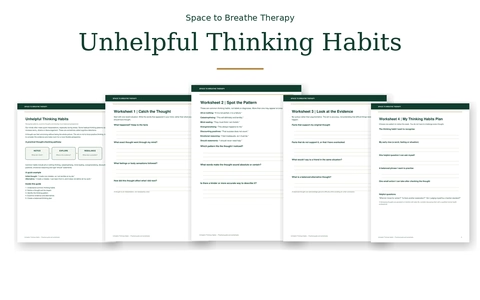
Unhelpful Thinking Habits is a practical five-page CBT-inspired guide and worksheet resource designed to help you recognise recurring thought patterns, understand how they affect emotions and behaviour, examine assumptions and develop more balanced ways of responding.
The aim is not to eliminate negative thoughts or force yourself to think positively. Instead, the resource encourages curiosity, self-awareness and greater flexibility in how you interpret experiences.
Understanding Unhelpful Thinking Habits
Our brains constantly interpret information, make predictions and attempt to understand what is happening around us.
These processes are useful, but they are not always accurate.
Previous experiences, emotional states, beliefs and expectations can influence how we interpret situations.
For example, imagine sending someone a message and not receiving a reply.
You might think:
“They must be annoyed with me.”
This thought could lead to anxiety, self-doubt or repeated checking of your phone.
However, there may be many other explanations. The person could be busy, distracted, unwell or simply unable to respond.
The guide introduces a visual thinking pathway to explore the relationship between:
Situation → Thought → Feeling → Response
Recognising this connection can help you understand how automatic interpretations influence emotional experiences and behaviour.
Importantly, thoughts are not always facts, and not every thought requires immediate action.
Common Unhelpful Thinking Habits
The resource introduces several patterns that may influence everyday thinking.
All-or-Nothing Thinking
Seeing situations in extremes, with little room for anything in between.
For example:
“If I cannot do this perfectly, I have completely failed.”
This pattern can make ordinary mistakes feel much more significant than they are.
Catastrophising
Automatically imagining the worst possible outcome.
For example:
“If I make a mistake at work, I will lose my job.”
This can increase anxiety and make uncertain situations feel threatening.
Mind Reading
Assuming that you know what another person is thinking without having clear evidence.
For example:
“They were quiet today, so they must dislike me.”
Fortune Telling
Predicting that something will go badly before it has happened.
For example:
“There is no point trying because I know it will not work.”
Overgeneralisation
Using one experience to make a broad conclusion about yourself or future situations.
For example:
“I struggled with that conversation, so I am terrible at communicating.”
Mental Filtering
Focusing on one negative detail while overlooking other relevant information.
For example, receiving several positive comments and one criticism but remembering only the criticism.
Discounting the Positive
Dismissing achievements, compliments or positive experiences.
For example:
“They only said I did well because they were being polite.”
Emotional Reasoning
Assuming that something must be true because it feels true.
For example:
“I feel inadequate, so I must be inadequate.”
Should and Must Statements
Placing rigid expectations on yourself or others.
For example:
“I should always be able to cope.”
Personalisation
Taking responsibility for events or other people's reactions when you may not be responsible.
For example:
“Everyone seems unhappy today. I must have done something wrong.”
These patterns can overlap, and experiencing them occasionally is a normal part of thinking.
The purpose of recognising them is to increase awareness rather than criticise yourself.
Worksheet 1 – Catch the Thought
Automatic thoughts can appear so quickly that we may not notice them.
We might recognise anxiety, frustration, embarrassment or sadness without immediately identifying the interpretation that contributed to those feelings.
The first worksheet, Catch the Thought, encourages you to slow down and explore a recent situation.
You can reflect on:
- What happened.
- What went through your mind.
- What emotions you experienced.
- How strongly you believed the thought.
- What you did in response.
For example:
Situation: A colleague did not acknowledge me.
Automatic thought: “I must have upset them.”
Feeling: Anxiety and embarrassment.
Response: Avoiding conversation and repeatedly thinking about what happened.
Writing down these experiences can help you recognise patterns that may otherwise remain automatic.
Worksheet 2 – Spot the Pattern
The second worksheet, Spot the Pattern, encourages you to identify the thinking habit that may be influencing your interpretation.
You might notice that you frequently predict negative outcomes, assume responsibility for other people's feelings or dismiss your own achievements.
Recognising recurring patterns can help you understand why certain situations trigger strong emotional responses.
The worksheet encourages you to explore:
- Which thinking habit may be present.
- What usually triggers it.
- Whether it appears in particular relationships or situations.
- How it affects your feelings and behaviour.
- What you might want to understand differently.
The aim is not to label every thought as distorted or unhelpful.
Some concerns are realistic and deserve attention.
Instead, the exercise encourages you to notice when your interpretation may be more rigid, negative or certain than the available evidence supports.
Worksheet 3 – Look at the Evidence
When a thought feels convincing, it can be difficult to consider alternative explanations.
The third worksheet, Look at the Evidence, introduces a practical CBT technique for examining thoughts more carefully.
You are encouraged to ask:
- What evidence supports this thought?
- What evidence might suggest another explanation?
- Am I making assumptions?
- Am I overlooking information?
- What would I say to someone I care about in this situation?
- Is there a more balanced way of understanding what happened?
For example:
Original thought: “I made one mistake, so I am terrible at my job.”
Evidence supporting the concern: I made an error that needed correcting.
Other relevant evidence: I usually complete my work successfully, and mistakes can happen.
Balanced perspective: “I made a mistake that I can learn from. It does not define my overall ability.”
A balanced thought does not need to be positive.
It simply aims to reflect the available information more accurately and compassionately.
Worksheet 4 – My Thinking Habits Plan
The final worksheet, My Thinking Habits Plan, brings together the techniques explored throughout the resource.
It encourages you to identify a recurring thinking pattern and develop practical ways of responding when it appears.
Your plan may include:
- A thinking habit you would like to recognise more easily.
- Situations that commonly trigger it.
- Early emotional or physical signs.
- Questions that help you examine the thought.
- A more balanced alternative perspective.
- One manageable action you could take.
- Ways to practise responding with greater self-compassion.
The aim is to develop awareness gradually rather than expecting your thoughts to change immediately.
With practice, you may become more able to notice automatic assumptions before they influence your response.
Thinking Habits, Anxiety and Emotional Wellbeing
Unhelpful thinking habits can contribute to anxiety, low mood, stress and difficulties with confidence.
For example, catastrophising may increase feelings of threat, while discounting positive experiences can make it difficult to recognise achievements.
Mind reading may affect relationships, particularly when assumptions lead to withdrawal, reassurance-seeking or avoidance.
Rigid expectations can also contribute to perfectionism and burnout.
Recognising these connections can help you explore why particular situations feel difficult and identify more flexible ways of responding.
However, not every distressing thought is inaccurate.
Sometimes thoughts reflect genuine problems, unfair treatment, discrimination or unmet needs.
The purpose of this resource is not to dismiss real difficulties but to help distinguish between evidence, assumptions and possible interpretations.
Thinking Habits, Disability and Neurodivergence
For autistic people, individuals with ADHD and others with neurodivergent experiences, thinking patterns may be influenced by additional factors.
These can include:
- Previous experiences of misunderstanding or rejection.
- Anxiety around uncertainty or unexpected change.
- Difficulties interpreting ambiguous communication.
- Strong emotional responses to criticism.
- Repeated experiences of masking or trying to meet expectations.
- Perfectionism developed through previous negative feedback.
- Cognitive overload and emotional exhaustion.
It is important not to assume that every concern is an unhelpful thought.
Some fears may be connected to genuine past experiences or ongoing barriers.
A compassionate approach involves recognising the context of the thought, validating the underlying experience and exploring whether the current interpretation is supported by the available information.
The aim is to develop flexibility without dismissing legitimate needs or experiences.
What Is Included?
This downloadable five-page PDF contains:
Page 1 – Understanding Unhelpful Thinking Habits
An introduction to automatic thoughts, common thinking patterns and the relationship between situations, thoughts, emotions and responses, including a visual diagram.
Page 2 – Catch the Thought
A reflective worksheet for recording a situation, identifying automatic thoughts and exploring the emotional and behavioural response.
Page 3 – Spot the Pattern
A practical worksheet for recognising recurring thinking habits and understanding when they tend to appear.
Page 4 – Look at the Evidence
A guided CBT-inspired exercise for examining assumptions, considering evidence and developing a more balanced interpretation.
Page 5 – My Thinking Habits Plan
A personalised worksheet for recognising triggers, practising helpful questions and developing realistic strategies for responding to recurring thoughts.
The worksheets provide space for personal reflection and can be completed independently or alongside therapy and coaching.
Who Is This Resource For?
Unhelpful Thinking Habits may be helpful for adults who:
- Experience anxiety or persistent worry.
- Frequently expect the worst.
- Struggle with perfectionism or self-criticism.
- Make negative assumptions about themselves.
- Find it difficult to recognise achievements.
- Experience low confidence or self-doubt.
- Repeatedly overthink conversations or situations.
- Want to understand the connection between thoughts and emotions.
- Experience stress or emotional overwhelm.
- Would benefit from practical CBT-inspired reflection exercises.
The resource may also support therapeutic conversations about anxiety, emotional regulation, self-esteem, perfectionism and cognitive flexibility.
A Gentle Reminder
You do not have to believe every thought that appears in your mind.
Thoughts can be influenced by stress, emotions, previous experiences and the information available to you at the time.
Sometimes your interpretation will be accurate. Sometimes there may be another explanation.
You are allowed to question assumptions, consider different perspectives and respond to yourself with greater understanding.
Changing thinking habits is not about ignoring difficult feelings or pretending that everything is fine.
It is about creating a little more space between what you think, what you feel and how you choose to respond.
A thought can feel powerful without being the whole story. You deserve the opportunity to explore it with curiosity rather than criticism.
Space to Breathe Therapy
This resource is intended for education, personal reflection and emotional wellbeing support. It uses CBT-inspired techniques but does not replace individual psychological, medical or professional advice. If distressing thoughts are persistent, significantly affecting your daily life or causing concern about your safety, consider seeking support from an appropriately qualified professional.




