





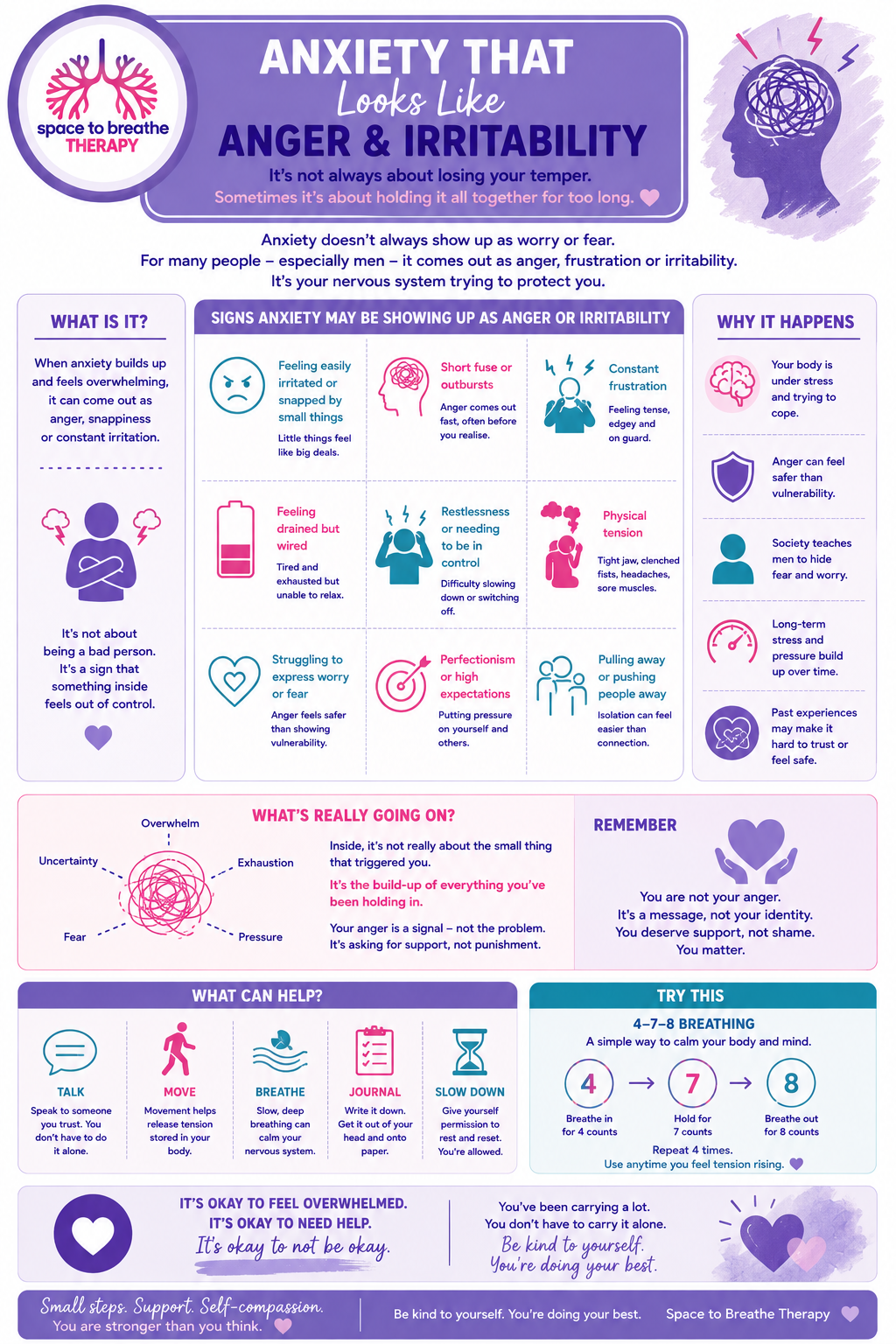
When Anxiety Comes Out as Anger
Looking Beneath the Reaction
Anxiety doesn't always look like someone sitting quietly worrying.
Sometimes it looks like irritability, frustration, snapping, impatience or anger.
Someone may not even recognise themselves as anxious. They may simply know that everything is irritating them, they're constantly on edge, small things feel enormous and they can't seem to switch off.
What we see on the outside can sometimes be very different from what is happening underneath.
The Anger May Be the Top Layer
Imagine you've been holding everything together all day.
You're tired.
Your mind hasn't stopped.
You're worrying about something you haven't told anybody about.
You've had too many demands and not enough time to recover.
Then somebody asks a simple question — and you snap.
It can look as though the question caused the anger.
But often, that question was simply the final demand on an already overloaded nervous system.
Underneath the reaction there may actually be:
Fear.
Pressure.
Uncertainty.
Exhaustion.
Overwhelm.
Feeling out of control.
Understanding what's underneath doesn't excuse hurtful behaviour, but it can help us work out what needs addressing.
A Tip From Me – Become Curious About the Reaction
After things have settled, try asking yourself:
“What was happening just before I reacted?”
Then go a little further.
“What had been happening all day?”
“What have I been carrying this week?”
“What am I worried about?”
“What haven't I said?”
Sometimes the answer isn't about that moment at all.
It's about everything that came before it.
Notice What Happens in Your Body
Anxiety is physical as well as emotional.
You might notice:
A tight jaw.
Clenched fists.
Tension across your shoulders.
A racing heart.
Restlessness.
Feeling hot.
Shallow breathing.
Feeling as though you need to escape.
These can become useful early warning signals.
The earlier you recognise them, the more opportunity you have to pause before the feeling becomes a reaction.
Create a Gap Between Feeling and Responding
You don't have to respond to everything immediately.
Try saying:
“I need a few minutes before we talk about this.”
Walk away if it's appropriate and safe.
Breathe.
Move.
Get some fresh air.
Write down what's going through your mind.
Allow your nervous system time to settle.
Taking space isn't avoiding the problem if you come back to it when you're calmer.
Sometimes that space prevents a difficult moment from becoming a damaging one.
If Someone You Care About Is Struggling
Try looking beyond the anger while still maintaining your own boundaries.
Instead of:
“Why are you always so angry?”
you might try:
“You seem really on edge lately. Is something going on?”
Or:
“You don't seem yourself. Do you want to talk?”
You can show compassion without accepting aggression or behaviour that makes you feel unsafe.
Both things can be true.
A Few Things That May Help
Talk.
You don't have to explain everything perfectly. Start with what you can say.
Move.
Physical movement can provide an outlet for built-up tension.
Slow down.
If you've been running at full capacity for weeks, your body may need recovery rather than another demand.
Notice your triggers.
Are there particular situations, environments, people or pressures that repeatedly leave you overwhelmed?
Reduce what you can.
Sometimes the answer isn't learning to tolerate more. It's carrying less.
Get support.
If anxiety, anger or irritability is affecting your relationships, work or everyday life, professional support can help you understand what's happening underneath.
A Message From Me
If you've become more irritable lately, don't immediately label yourself as an angry person.
Behaviour is information.
Ask what it might be telling you.
Maybe you've been holding everything together for too long.
Maybe you're exhausted.
Maybe you're frightened.
Maybe your boundaries have disappeared.
Maybe you're overwhelmed and haven't known how to say it.
You are responsible for how you treat other people, but you also deserve the opportunity to understand why you're struggling rather than simply feeling ashamed of the reaction.
Look beneath the anger.
Listen to what your mind and body are trying to tell you.
And get support before everything has to become unbearable.
Sometimes anger is the part we can see. Anxiety is the part we haven't noticed yet.
Until next time, give yourself Space to Breathe.
Maggie
Space to Breathe Therapy