





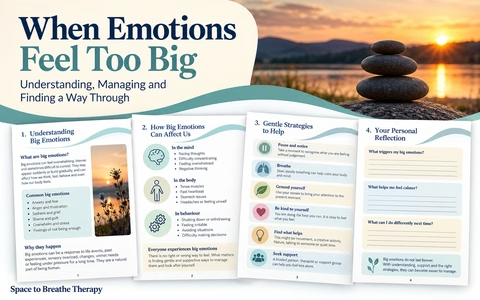
When Emotions Feel Too Big
Understanding Big Emotions
What are big emotions?
Sometimes a feeling arrives so strongly that it seems to fill every available space. Fear can make a small decision feel impossible. Anger may rise before you have found the words to explain what has happened. Sadness can feel heavy, while shame can make you want to disappear.
Emotions are not a measure of weakness. They are signals that something matters, something hurts, or something in your environment or body needs attention. They may grow quickly or accumulate slowly over days and weeks.
Anxiety and fear · Anger and frustration · Sadness and grief · Shame and guilt · Overwhelm and stress · Feeling that you are not enough
Why might they feel so intense?
Sleep loss, prolonged stress, uncertainty, conflict, grief, sensory overload and unmet needs can all reduce the room we have to respond. Past experiences may also shape what feels threatening today. For some neurodivergent people, emotional intensity may be connected with sensory demands, transitions or difficulty identifying internal sensations.
Two people can experience the same event differently. Neither response needs to be dismissed. Understanding the context of a feeling often helps more than judging its size.
You do not have to solve an emotion the moment it appears. You can begin by recognising it.
Explore what you are feeling
Choose any words that fit. More than one can be true at once.
How Big Emotions Can Affect Us
Emotions are not confined to thoughts. They can influence breathing, muscles, digestion, concentration, energy and how we connect with other people. Recognising your own early signs can help you respond before you reach your limit.
In the mind
Racing thoughts, difficulty concentrating, harsh self-talk, indecision, or feeling that everything is urgent.
In the body
Tight shoulders, shallow breathing, a fast heartbeat, stomach discomfort, headaches, or feeling frozen.
In behaviour
Withdrawing, snapping, avoiding tasks, seeking repeated reassurance, becoming restless or shutting down.
Why the body reacts
When your nervous system detects danger or excessive demand, it may prepare you to fight, flee, freeze or seek safety. This can happen even when the situation is emotionally difficult rather than physically dangerous. Your body may respond before you can clearly explain what you feel.
Some people become highly activated: tense, restless, alert or tearful. Others become quiet, numb, distant or unable to speak. Both patterns deserve understanding rather than criticism.
The earliest clue might be a clenched jaw, a change in breathing, an urge to leave, difficulty processing speech, or a sudden need for silence. You do not need to wait until you are overwhelmed to offer yourself support.
My emotional early-warning signs
Gentle Strategies to Help
There is no single technique that works for everybody. The aim is not to force an emotion away, but to make the next moment a little more manageable. Choose what suits your body, circumstances and sensory needs.
Try saying, “This is a strong feeling, and I can take one moment.” Naming an experience can create a little space around it.
If breathing exercises help, gently lengthen your exhale without forcing it. If they feel uncomfortable, skip them and try another approach.
Feel your feet on the floor, hold a familiar object, or notice three colours around you. You can keep your eyes open.
Replace “I should cope better” with “This is difficult, and I deserve support while I work through it.”
A quieter room, movement, water, a warm blanket, music, rest or a change of environment may reduce the demands on you.
Ask someone to sit with you, listen, help with one task or give you space. You can be specific about what you need.
A gentle breathing visual
Press start to follow a slow visual rhythm. Stop whenever you wish; there is no need to hold your breath.
Your Personal Reflection
You know your experiences better than anybody else. Reflection is not a test and does not require perfect answers. You can leave any question blank, return later or simply notice what feels important today.
What triggers my big emotions?
Think about situations, relationships, sensory experiences, expectations or periods of exhaustion. You might notice patterns rather than a single cause.
What helps me feel calmer?
Consider people, places, objects, routines or boundaries that offer some steadiness. It is fine if a strategy only helps a little.
What could I do differently next time?
Choose one small, compassionate response rather than a long list of changes. The aim is to make support easier to reach.
Big feelings do not have to be managed alone. If intense emotions are frequent, frightening or disrupting daily life, a trusted professional can help you explore what is happening and what support might fit.
My small support plan