




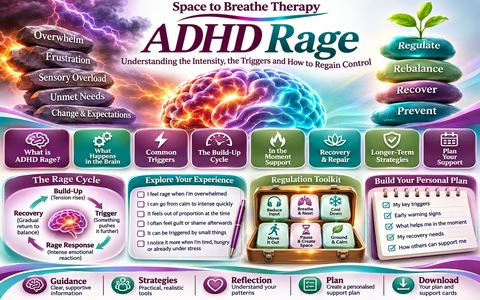
ADHD Rage
When frustration, overload or distress escalates quickly, it can feel frightening and difficult to interrupt. Explore what might be happening, find support for the moment, and build a plan that respects your needs and other people's safety.
Explore the intensity
Use the interactive brain and intensity scale to explore different states. This is a visual metaphor for emotional experience, not a measurement of brain activity, hormones or risk.
Early warning signs
What can contribute?
ADHD may involve difficulties with emotional inhibition, attention shifting, impulsivity and coping with competing demands. Sleep loss, sensory stress, pain, trauma, anxiety, medication effects and other health factors can also matter.
The brain illustration is educational artwork, not a scan or proof of a particular mechanism.
The escalation pathway
Not everyone follows these steps, and recovery may move backwards and forwards. The goal is understanding and safer support, not judging the emotion.
What do you need right now?
These large communication cards can be shown to someone without having to explain everything aloud. Select a card to display the message; use “Show full screen” for an easier-to-read version.
Reduce background noise if possible. I need fewer sensory demands.
For someone supporting me
Speak slowly and briefly if communication is welcome. Offer choices without pressure. Give physical space and do not touch unless there is consent or an immediate safety necessity. Move hazards away when safe; avoid confrontation or arguing about what happened.
Understand your triggers and warning signs
Choose experiences that fit. A trigger is not an excuse for harm; recognising patterns can make it easier to intervene early and ask for appropriate support.
What increases pressure?
What do you notice first?
Why this can feel so sudden
Being pulled away from a demanding or absorbing task may make it harder to pause and reorient.
Some people with ADHD find it difficult to create space between a strong feeling and a response.
Sleep, sensory input, stress, medication timing and unmet needs can reduce available coping capacity.
These are possible contributors, not a universal explanation. Frequent or severe anger deserves assessment for other causes and co-occurring conditions too.
Choose a regulation tool
There is no single technique that works for everyone. At high intensity, prioritise safety and reducing demands; reflective techniques often work better after the peak.
🔇 Reduce input
Lower sound, brightness and conversation. Move to a quieter space if safe.
↔️ Create space
Agree on a pause, step away from conflict and return when everyone can communicate safely.
🚶 Safe movement
Walk, stretch, push against a wall or use another preferred form of movement without harming yourself or others.
🧊 Temperature and comfort
Try a cool cloth, fresh air or a comfortable temperature change if this feels safe and helpful.
🗣 Communication cards
Use a short message such as “I need space” instead of explaining or debating during overload.
🥛 Meet basic needs
When possible, check water, food, pain, fatigue, medication routine and a quieter place to rest.
🌬 Gentle breathing
If comfortable, allow the exhale to be unhurried. Skip breathwork if it increases discomfort or panic.
🧱 Grounding
Notice the support of your feet or chair, or hold a familiar object. Avoid forced sensory exercises.
📝 Externalise later
Once settled, jot down what happened, what helped and what could change next time—without self-criticism.
Practice: choose what is realistic at each stage
Recovery, repair and longer-term support
After an intense episode
Allow time for fatigue, sensitivity or shame to settle. Reduce stimulation and meet basic needs before analysing.
Ask what contributed to escalation, what boundaries were crossed and what would make future situations safer.
Where appropriate, acknowledge the impact on others, apologise for harmful behaviour and agree on practical changes. Avoid demanding immediate forgiveness.
Look for preventable demands, unclear communication, unmet needs or recurring conflict patterns.
For partners, family, colleagues and supporters
During escalation: use calm, concise communication; give space; avoid sarcasm, threats or forced eye contact; and keep everyone safe. Ask what helps at a calm time rather than guessing during the peak.
Afterwards: listen to the person's experience while also recognising anyone affected. Collaboratively agree on boundaries, time-out signals, practical adjustments and repair.
Children and young people: adults remain responsible for supervision and safety. Do not rely on a child to regulate alone or use support cards as a substitute for appropriate care.
Common questions
Does everyone with ADHD experience rage?
No. ADHD does not automatically cause rage or violence. Emotional regulation difficulties are reported by some people with ADHD, but experiences vary widely. Strong anger can also relate to other factors.
Is this the same as an autistic meltdown?
Not necessarily. A meltdown is often described as an involuntary response to overwhelming demands or sensory/emotional overload. An intense anger response can overlap with overload, but the experiences are not identical and should not be assumed to have the same cause.
What if breathing exercises make things worse?
Do not force them. Choose sensory reduction, movement, space, familiar objects or other supports that feel safe and accessible. Some people find breathing instructions intrusive during intense distress.
What if I feel ashamed afterwards?
Shame can make it harder to ask for support. You can take responsibility for actions without treating yourself as a bad person. Rest, reflect when ready, repair harm where appropriate and identify changes that may help prevent recurrence.
Can medication or hormones affect emotional intensity?
Medication timing, side effects, sleep and hormonal changes may affect emotional wellbeing for some people. Do not change prescribed treatment on your own; discuss noticeable changes with a prescriber or clinician.
What if someone is frightened or unsafe?
Prioritise immediate safety, separation from danger and urgent help where necessary. Do not ask anyone to stay in an unsafe situation in order to provide emotional support. If there is immediate danger in the UK, call 999.
Build your personal support plan
Select your triggers, warning signs and helpful tools above, then add your own words below. Your plan is for collaboration and preparation—not a requirement to complete during distress.
Your live plan preview
Saving uses this browser's local storage when available. It is not an encrypted clinical record; other people using this browser profile may be able to access saved answers. Copy or print to keep your own version. Clearing removes saved answers from this resource on this browser.

Your submission has been received!






Registered Office : 20 Haccombe Path, Newton Abbot, TQ12 4JB
Company Reg No: 13576583 - Copyright © Space To Breathe Therapy
