



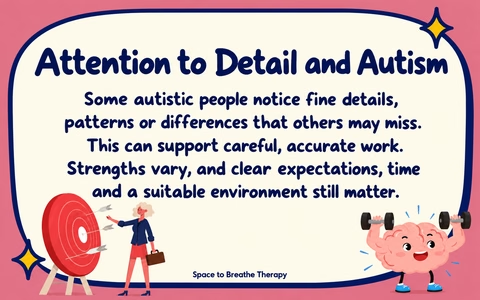

Attention to Detail and Autism

Explore attention to detail and autism through practical examples, supportive choices and gentle reflection. Recognise your individual strengths, understand what makes detailed work easier or harder, and create a downloadable support map with clear expectations, comfortable conditions and manageable boundaries.

Download
Attention to Detail and Autism

DETAIL • CONTEXT • SUPPORT

Attention to Detail and Autism

Value what you notice, and the conditions that help you.

Some autistic people describe noticing fine details, patterns or inconsistencies as a strength. Everyone is different, and attention can vary with interest, energy and surroundings. Being autistic does not mean being accurate all the time.

What do you notice?

Explore an example. These are possibilities, not expectations.

Choose an example above.

Make careful work more manageable

Choose a support to explore.

Accuracy does not require perfection

Attention to detail can be useful, but no one should be expected to catch every error. Agree which details matter, what checking is needed and when the task is complete.

If repeated checking feels distressing or difficult to stop, support can help you explore what is happening. You do not have to dismiss the difficulty as simply part of being autistic.

My detail and support map

Your writing stays on this page while it is open. It is not saved automatically. Download it if you want a copy.

Individual strengths

A strength can coexist with substantial support needs. This reflection is not a test of accuracy, ability or autism.

National Autistic Society: individual strengths and work

Space to Breathe Therapy



