



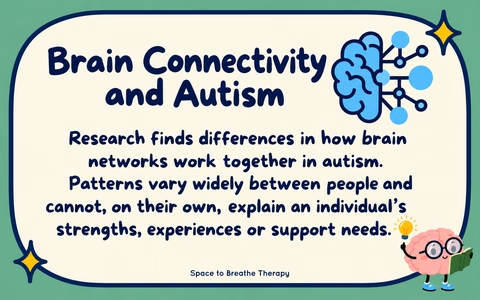

Brain Connectivity and Autism

Explore brain connectivity and autism through accessible explanations, interactive perspectives and personal reflection. Understand the limits of research findings, recognise individual differences, and create a downloadable experience and support map that highlights your strengths, challenges, preferences and what helps you.

Download
Brain Connectivity and Autism

RESEARCH • INDIVIDUALITY • UNDERSTANDING

Brain Connectivity and Autism

Explore the research without losing sight of the person.

Researchers study how different brain regions are connected and how their activity relates over time. Studies comparing groups have found differences in autism, but patterns vary widely. A group finding does not tell us exactly how one person thinks, feels or learns.

Unpack the terminology

Choose a term for a plain language explanation.

Choose a term above.

Look beyond the headline

Start with lived experience

These are examples of questions to ask someone, not predictions from a scan. Choose an area to explore.

The person’s own account helps guide useful support.

My experience and support map

This reflection does not measure brain connectivity or assess autism. Your writing stays on this page while it is open and is not saved automatically.

Research and its limits

Functional MRI looks at changes related to blood oxygenation. Functional connectivity describes statistical relationships between activity signals; it does not directly count physical connections or read thoughts. Results depend on the people studied, their age, the task or resting conditions, and how the data are collected and analysed.

Research can improve understanding, but a simple “more connected” or “less connected” label cannot capture an individual’s life. This activity offers education and reflection, not a scan, diagnostic test or treatment.

Research: individual variation in functional connectivity in autism

Space to Breathe Therapy



