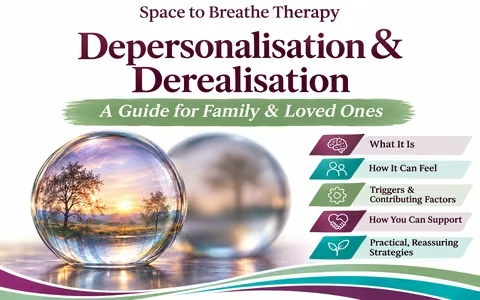
Depersonalisation & Derealisation — A Guide for Family & Loved Ones
Understand depersonalisation and derealisation with this compassionate guide for family and loved ones. Discover how these experiences feel, recognise possible triggers and learn practical reassurance strategies. Includes interactive worksheets, communication guidance and personalised support planning. Download the full guide above.
Depersonalisation & Derealisation | Support Worksheets
Space to Breathe Therapy
Depersonalisation & Derealisation
A practical support studio for family & loved ones
Understand the experience
Learn what your loved one might be describing before trying to help.
Depersonalisation
Feeling detached from yourself, your body, emotions or actions. Someone might say, “I feel like I’m watching myself” or “I’m on autopilot.”
Derealisation
Feeling disconnected from the world. Places and people can seem distant, dreamlike, unfamiliar or unreal even when someone recognises them.
What family members often misunderstand
Someone can look composed and still feel frightened. These experiences are not a choice. Avoid demanding explanations or insisting they “snap out of it.” Many people know that the feeling of unreality is a sensation, not a change in reality.
What can contribute?
Stress, panic, anxiety, trauma, sleep loss and sensory overload may contribute. Some medical conditions, substances or medications can cause similar symptoms. A healthcare professional can assess new or persistent symptoms.
Notice signs and reduce pressure
Select signs that might be relevant. These are possibilities, not a checklist for diagnosis.
What might I notice?
Reduce the load
Lower noise, reduce questions, slow your speech, offer a quiet space and check whether company is wanted. Ask before touching. If they are driving or in another unsafe situation, prioritise physical safety.
Choose a supportive response
Try each situation. Select a response to reveal feedback.
Situation 1: “Nothing around me feels real.”
Situation 2: They become quiet and cannot answer quickly.
Situation 3: You want to suggest grounding.
Build a gentle grounding menu
Choose only options the person welcomes. Grounding is an invitation, not a test.
Important
Some people find body scans, strong sensations or breathing instructions distressing. Stop any exercise that makes things worse. Do not force eye contact, touch or conversation.
Create our shared support plan
Complete this together when the person feels ready. Save, export or print the plan.
When professional support matters
New, persistent, worsening or disruptive symptoms should be assessed by a healthcare professional. Sudden confusion, new neurological symptoms, seizure-like symptoms or immediate safety concerns need urgent medical assessment. In the UK, call 999 in an emergency or NHS 111 for urgent advice when it is not an emergency.
For the supporting person
You can offer reassurance and practical support without becoming responsible for fixing every symptom. Your boundaries, rest and wellbeing matter too.