





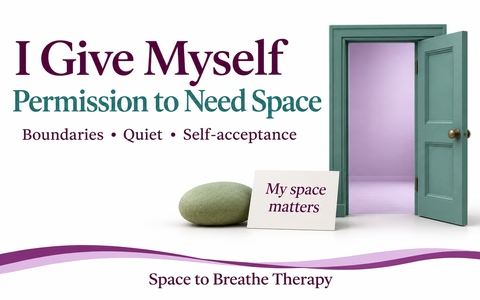
I Give Myself
Permission to Need Space
Turn “I need space” into a request you can use. Notice your early signs, choose the kind of space that helps, practise the words and leave with your own printable plan.
Responses can be saved in this browser. Download a copy to keep your own record.
1. Make room for yourself
The door represents your availability to other people. Choose how much contact feels manageable, then choose the demands you want to reduce. Your choices will create a request you can take into your plan.
What would help right now?
Tap a word beside the door, or a button below, to send that demand out. Choose as many as you need. Tap its button again to bring it back.
A partly open door can mean that you want connection with a little more room around it.
Closed: a pause from contact. Partly open: limited contact. Open: contact feels welcome. Choose what fits; you can change your mind.
Connection with some room
A clear request, the signs that tell you when to use it, and a practical plan for taking space and checking in. You can complete only the parts that help today.
Permission without an apology
Needing space does not require a dramatic reason. You can want quiet, time to think, fewer questions or a little privacy. These needs can sit alongside caring about other people.
Choose a reminder you would like to hear today.
2. Notice my early signs
You do not need to wait until things feel unbearable to ask for room. Think about what you notice before you reach your limit.
When I cannot name what is happening
You can start with something concrete: “I need fewer questions,” “I cannot decide yet,” or “I need somewhere quieter.” You do not have to produce a perfect explanation before expressing a need.
A check-in without a score
Which phrase describes your capacity right now? This is a snapshot, not a label.
You can choose a phrase or leave this unanswered.
3. Choose the space I need
Space can take different forms. Select what fits now; your choices are allowed to change.
When I cannot leave
A smaller adjustment may still be possible: reducing the number of questions, taking turns speaking, using written information, changing seats, or agreeing not to make a decision immediately. Choose something realistic for the setting.
When I want company and space
You might want someone nearby without talking, a familiar person to check in later, or quiet companionship. “I need space” does not have to mean “I want to be completely alone”.
4. Find words that fit
Build a phrase you could say, write or show someone. You choose how much detail to include.
If someone hears “space” as rejection
If it fits, you could say: “I care about this conversation. I need a pause so I can give it more attention.” Reassurance can help clarify your intention, but you do not need to promise more contact than you can manage.
If my request is not accepted
You can repeat a short boundary without adding more personal detail: “I cannot discuss this now.” Consider who could support you or what practical options are available. You are not responsible for finding a perfect phrase that controls another person's response.
5. A pause that works for me
A useful plan describes the space you want and what happens next. A check-in can be a brief update; it does not have to mean you are ready to resume everything.
Try a real-life situation
Choose a situation and try a response. These are possibilities to reflect on, not a test of the “right” way to speak.
A pause and an unresolved issue
Taking space can be a choice about timing. If something still needs discussion, you can decide how and when to return to it, or ask for help with that conversation. A boundary can include both “not now” and a realistic next step.
6. My permission card
Your card gathers your choices. Keep it for yourself or share only what feels right.
I give myself permission to need space
My early signs
The space I need
How I can ask
During my space
My check-in
If I need longer
My support
My space matters. My needs matter.
Space to Breathe Therapy




