





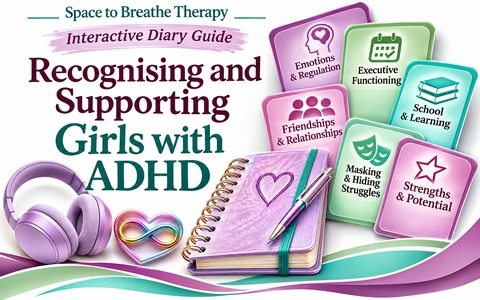
Recognising and Supporting Girls with ADHD
A supportive place to notice what is happening beneath the surface, explore what helps, and record experiences without judgement. For girls, parents, carers and professionals to use together or independently.
ADHD can look different from person to person. These examples are possibilities, not a diagnostic checklist. Girls may be inattentive, hyperactive, impulsive, or experience a combination.
Explore the colourful guide cards
Select any card to open detailed explanations, helpful responses and a reflection prompt.
What may be missed?
What others might see
- A quiet, capable or high-achieving girl
- Daydreaming, forgetting or losing belongings
- Talking a lot, moving constantly or interrupting
- Perfectionism, people-pleasing or reluctance to ask for help
- Strong feelings after school rather than during it
What she may be experiencing
- Effortful attention and mental exhaustion
- Overwhelm from instructions, noise or social expectations
- Fear of mistakes, rejection or being judged
- Difficulty starting, switching or finishing tasks
- Pressure to hide differences and appear fine
Important: Being successful at school does not rule out ADHD. Nor does being lively, quiet, anxious or emotional confirm it. A full assessment considers history, settings, impact and other possible explanations.
Today, beneath the surface
There are no right answers. Write, type, draw on paper, or complete only the parts that feel useful. Your entries stay in this browser unless you choose to export them.
Saved diary entries
My seven-day wellbeing tracker
Notice patterns rather than grading yourself. You can leave days blank. Record energy and pressure from 0–10 and what made a difference.
| Day | Energy 0–10 | Pressure 0–10 | What helped? |
|---|
High pressure can reflect unmet support needs, not a lack of effort. Look for repeated triggers and accommodations that make things easier.
Support that makes a difference
For parents, carers and educators
Ask what support is useful rather than assuming. Offer clear instructions, manageable steps, visual reminders, movement and sensory breaks, and time to recover after demanding situations. Avoid treating masking as proof that everything is fine.
In the UK, families can discuss concerns with a GP or an appropriate qualified professional, and ask the school or college about reasonable adjustments and SEND support. Support at school does not always need to wait for a diagnosis.
A note about assessment and wellbeing
ADHD assessment considers persistent difficulties, their impact in more than one setting, developmental history and other explanations. Anxiety, sleep difficulties, autism, trauma and learning differences may overlap or coexist. Girls and young women can be overlooked when their difficulties are hidden by effort or coping strategies.
If a young person is in distress or at risk of harm, seek prompt support from an appropriate health professional or urgent local service. This resource is educational and is not a diagnostic assessment or a substitute for individual care.




