





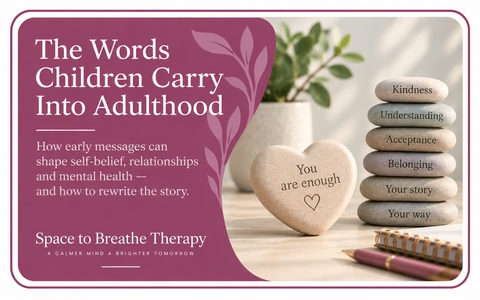
THE WORDS CHILDREN CARRY INTO ADULTHOOD
How early messages can shape self-belief, relationships and mental health — and how to rewrite the story
Words can stay with us for much longer than the moment in which they were spoken.
For neurodivergent children, childhood can involve an enormous amount of correction. “Stop fidgeting.” “Why can’t you just try?” “You’re too sensitive.” “You never listen.” “Why can’t you be more like your brother or sister?” Sometimes these words are spoken by exhausted, worried parents who are trying their best with the understanding they have at the time. But intention and impact are not always the same.
This detailed Space to Breathe Therapy resource explores how repeated messages in childhood can become part of the way a person understands themselves.
It looks at identity labels such as lazy, difficult, dramatic, rude, selfish, over-sensitive or attention-seeking, and considers what may have been happening underneath behaviour that adults found difficult. Executive dysfunction, sensory overload, communication differences, impulsivity, emotional regulation and the effort involved in masking can all be misunderstood when neurodivergence is unrecognised.
The resource is deliberately not about blaming parents. Families are human. Parents become tired, frightened and frustrated. Many parents also repeat the parenting language they experienced themselves. One difficult conversation does not define an entire childhood.
Instead, the guide asks what happens when a message becomes a pattern — and what happens when that pattern follows a child into adult life.
It explores how childhood messages may later appear as an inner critic, people-pleasing, perfectionism, excessive apologising, fear of criticism, difficulty trusting your own judgement, trouble setting boundaries or the belief that love has to be earned by being easy, useful or successful.
There is a dedicated section on late neurodivergent diagnosis and the experience of looking back at childhood with new information. Behaviour once described as laziness, stubbornness or being “too much” may make much more sense when ADHD, autism or other neurodivergent needs are finally recognised.
The guide also explores what happens when parents continue using childhood labels after their child has become an adult, how family stories can freeze somebody in an old role, and how adult children can set boundaries around language, jokes and stories that no longer feel acceptable.
For parents, there is practical guidance on repairing relationships even years later. A meaningful apology does not require a parent to agree with every memory. It requires curiosity about impact, ownership of specific behaviour and a willingness to communicate differently now.
For adults carrying painful childhood messages, the guide includes a “Whose voice is this?” reflection exercise to help identify inherited beliefs and replace them with language that is more accurate rather than simply more positive.
Included:
• neurodiversity-affirming information
• parent intention versus child impact
• criticism, comparison and shame
• masking and belonging
• internalised messages and the inner critic
• adult relationships and boundaries
• late diagnosis and reinterpreting childhood
• becoming a parent yourself
• meaningful apology and repair
• “Whose voice is this?” worksheet
• practical language alternatives
• supportive message
• references and evidence notes.
The central message is simple: a story repeated throughout childhood can feel like the truth without actually being the truth.
You can understand where that story came from and still choose not to carry it forever.
Space to Breathe Therapy
A calmer mind, a brighter tomorrow.