





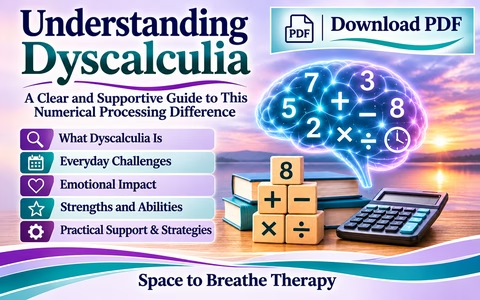
Understanding Dyscalculia
A Five-Page Visual Guide to Understanding Numerical Processing Differences
Understanding Dyscalculia is a detailed, five-page educational PDF designed to help individuals, families, educators, employers and professionals develop a clearer understanding of dyscalculia and how it can affect everyday life.
Dyscalculia is much more than finding mathematics difficult. It can influence how someone understands quantities, processes numerical information, manages time, handles money, follows instructions and completes tasks involving numbers.
This guide explores the condition beyond the classroom, recognising both the practical difficulties and the emotional experiences that can accompany it.
The PDF combines detailed written explanations, real-life examples, visual diagrams, practical strategies and reflective questions, presented across five coordinated sections.
Page 1 – What Dyscalculia Is
The first page introduces dyscalculia as a neurodevelopmental learning difference and explains how it affects number processing.
It explores:
- Number sense and understanding quantities.
- Recognising numerical relationships and sequences.
- Remembering number facts and following calculations.
- Why difficulties can vary between individuals.
- How dyscalculia can occur alongside ADHD, autism or dyslexia.
- Common misconceptions about intelligence, motivation and mathematical ability.
A visual diagram illustrates three areas of numerical processing: quantity, sequence and calculation.
The page also helps readers recognise possible patterns of difficulty and consider which part of a numerical task creates the greatest barrier.
Page 2 – Everyday Challenges
This section explains how dyscalculia can affect activities that many people encounter every day.
It explores difficulties with time management, appointments, journey planning, shopping, budgeting, cooking, measurements, travel information and workplace tasks.
Practical examples demonstrate how an apparently simple activity, such as arriving at work on time, may involve several demanding calculations.
A visual comparison of time, money and measurements introduces practical ways of reducing these demands.
The page also examines the hidden effort involved in checking figures, preparing for activities and managing numerical information.
Page 3 – Emotional Impact
Dyscalculia can affect more than numerical confidence.
This page explores how repeated mistakes, criticism, embarrassment and misunderstanding may contribute to anxiety, avoidance and reduced self-confidence.
It includes a visual explanation of the cycle between numerical demands, increasing pressure and emotional impact.
Readers will learn why being told to concentrate harder or try again may not address the underlying difficulty.
The section also explores supportive communication, privacy, disclosure choices and ways to rebuild confidence through understanding and appropriate adjustments.
Page 4 – Strengths and Abilities
This section encourages readers to recognise the whole person rather than defining someone by their difficulties with numbers.
It explores individual abilities that may include communication, creativity, practical problem-solving, visual thinking and interpersonal skills, while recognising that everyone's strengths are different.
A three-part visual highlights communication, practical insight and creative thinking.
The page also explains why using calculators, digital tools, templates and other forms of support does not diminish someone's competence.
Reflective questions encourage readers to identify their existing abilities, successful approaches and environments where they can work confidently.
Page 5 – Practical Support & Strategies
The final page brings together realistic approaches for making numerical tasks clearer and more manageable.
It covers written instructions, visual schedules, calculators, digital reminders, labelled measurements, checking systems and accessible working methods.
A four-step visual strategy introduces:
- Pause – Understand what the task is asking.
- Separate – Identify the figures, information and units.
- Support – Use an appropriate tool, template or calculation method.
- Check – Review the information and confirm the result.
The page also explains possible adjustments in education, home and employment, including relevant UK workplace support and Access to Work.
Readers are encouraged to identify one numerical difficulty, select a practical adjustment and review whether it makes everyday tasks easier.
What This PDF Provides
This resource offers an accessible, visually structured explanation of dyscalculia, combining education with practical understanding.
It can be used for personal learning, professional awareness, conversations with family members, educational support or workplace discussions.
The aim is not to make someone better at coping without support, but to help them understand their needs, recognise their abilities and access approaches that make everyday life more manageable.
Space to Breathe Therapy




