





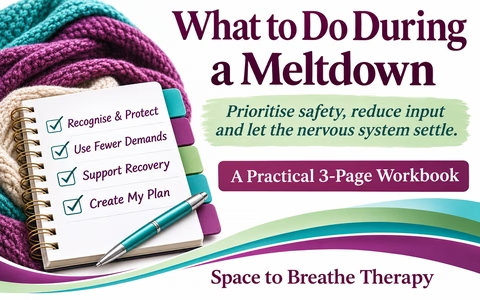
What to Do During a Meltdown
A practical, compassionate three-page guide to recognising overwhelm, responding safely, reducing demands and supporting recovery. Includes helpful strategies and a personalised support plan.
Recognise & protect
Start with safety, not explanations. A meltdown is not a choice or a teaching moment.
What may be happening
A meltdown can occur when demands, sensory input, emotions or uncertainty exceed a person’s capacity to cope. It may involve crying, shouting, movement, panic, loss of speech or an inability to process instructions. Some people become very still or withdraw instead. Do not assume you know the cause.
Notice the early signs
Look for pacing, repetitive questions, covering ears, faster breathing, agitation, difficulty choosing, changes in speech, withdrawal or a sudden need to escape. Signs vary by person; ask about them when everyone is calm.
First 60 seconds: a safety check
Lower your voice and slow your movements. Check for immediate hazards, traffic, sharp objects, unsafe exits or risk of injury. Give physical space and a clear route to a safer, quieter place. Keep other people and onlookers away when possible.
If there is immediate danger
Protect yourself and others without punishment or confrontation. Avoid restraint or blocking an exit except where an immediate danger makes intervention unavoidable and you are trained and authorised. Seek emergency help for serious injury, breathing problems, loss of consciousness or imminent danger.
What not to do
Avoid filming, threatening consequences, arguing, demanding eye contact, asking repeated questions, touching without consent, or insisting that the person explain themselves. These responses can increase distress. Do not treat the meltdown as deliberate misbehaviour.
A simple safety sequence
1. Notice signs of overload. 2. Check for danger. 3. Reduce people, noise and demands. 4. Give space and time. 5. Seek urgent help if someone is in immediate danger.
My reflection & support plan
Complete when calm. Skip anything that is not useful.
Reduce demands & input
Use fewer words, offer choices without pressure, and allow time for the nervous system to settle.
What to do in the moment
Use short, concrete phrases such as “You are safe”, “I am here”, or “I can give you space”. Say one thing at a time, then pause. Do not insist on eye contact, answers, apologies, breathing exercises or a conversation.
Change the environment
Reduce lights, noise, crowding, touch, smells and interruptions where practical. Silence notifications, move spectators away, and offer a familiar quiet space. Ask before touching; a hug or hand on the shoulder may increase distress.
Offer simple options — not a quiz
If choices are welcome, try “Space or company?”, “Water nearby?”, or “Shall I turn the light down?” A nod, gesture, pointing or no response may be all the person can manage. If choices add pressure, quietly make the environment safer and wait.
If communication becomes difficult
Treat silence, repeated words, movement, tears or an inability to speak as possible signs of overload. Avoid debating facts, explaining consequences, correcting behaviour or asking “Why are you doing this?” Keep your language neutral and predictable.
If you are supporting someone
Stay aware of your own regulation and safety. If you feel frightened or at risk, move to safety and seek appropriate help. Supporting someone does not mean accepting violence, threats or harm.
Helpful scripts for supporters
Instead of “Calm down”, try “I can stay nearby.” Instead of “Tell me what happened”, try “No need to talk now.” Instead of “Stop doing that”, try “Let us move somewhere quieter.” A familiar agreed phrase is often better than lots of reassurance.
If nothing seems to work
There may be no immediate fix. Stop adding new strategies every few seconds. Stay predictable, keep the space safe, and allow recovery at the person’s pace. Only use grounding, breathing or sensory tools if the person has previously said they help.
My reflection & support plan
Complete when calm. Skip anything that is not useful.
Recover without shame
After the crisis, focus on rest, reconnection and a plan made collaboratively.
Recovery may take time
After a meltdown, someone may feel exhausted, shaky, embarrassed, sensitive to sound or unable to talk. Offer water, food, medication if prescribed and due, rest or quiet companionship according to preference. Avoid immediate debriefing.
Reconnect gently
Later, when both people are ready, try: “What would have helped?” or “Would you like us to make next time easier?” Listen without blame. If you made a mistake, acknowledge it simply. There is no need to force an apology or detailed account.
Make a practical prevention plan
Identify patterns without treating the person as the problem: sleep, pain, hunger, sensory load, transitions, unclear expectations, conflict or cumulative demands. Plan breaks, predictable routines, communication alternatives and an agreed signal for stepping away.
When extra support matters
Seek professional advice if meltdowns are frequent, escalating, cause injury or substantially affect daily life. A clinician can help explore distress, pain, trauma, communication needs and other possible causes. For immediate danger or a medical emergency, contact emergency services.
A shared agreement for next time
When calm, agree on one signal for “I need space”, one safe place, who should stay nearby, which sensory changes help, and when outside support is needed. Review the plan together after trying it; needs may change over time.
A reminder for everyone involved
A meltdown is not a moral failure. Support should preserve dignity, choice and safety. People supporting someone also deserve rest, boundaries and support of their own.
My reflection & support plan
Complete when calm. Skip anything that is not useful.