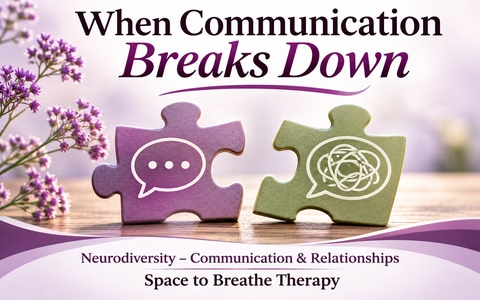
Explore why communication breaks down, particularly when neurodivergent differences, sensory overload and emotional overwhelm affect understanding. Through interactive activities, visual diagrams and reflective exercises, recognise misunderstandings, identify triggers and discover practical strategies to rebuild connection, improve communication and strengthen relationships.
Explore the gap between intention and interpretation, and find a way back to understanding.
The listening gap
Two people can experience the same conversation differently. Silence may be processing time; a request for clarification may be heard as criticism.
What I meant
“I need time to find the right words.”
What was heard
“You don't want to talk to me.”
What gets in the way?
Processing time, sensory overload, exhaustion, literal interpretation, different expectations and past experiences can all affect communication. These are possibilities, not assumptions about any individual.
Try identifying one barrier before trying to solve the whole disagreement.
The breakdown cycle
A comment feels unclear
↓
Meaning is assumed
↓
Someone defends or withdraws
↓
Both feel unheard
↓
Pause · Check meaning · Choose a next step
Reconnecting
Pause: “I want to continue, but I need a break. Can we return at 7?”
Clarify: “I think I understood something differently. What did you mean?”
Adjust: Try writing it down, slowing the pace or discussing one topic at a time.
Repair: Acknowledge the impact and agree on a small change.
My communication agreement
Use these prompts alone or together. Each person's needs matter.
Reflections are stored only in this browser, when browser storage is available.
Try a different response
Select a difficult phrase and explore a less confrontational alternative.
Choose a phrase above to explore a possible response.