





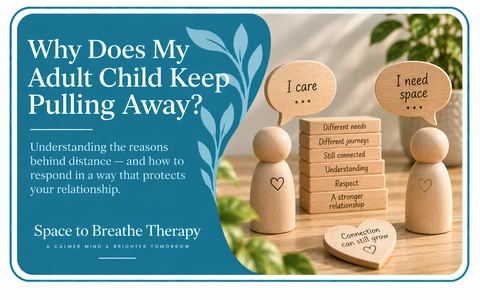
WHY DOES MY ADULT CHILD KEEP PULLING AWAY?
When an adult child starts replying less, visiting less often or sharing less about their life, parents can feel deeply rejected.
But distance does not always mean a lack of love.
This detailed Space to Breathe Therapy resource explores the many reasons a neurodivergent adult may need more space from their parents and, importantly, what parents can do that makes connection more rather than less likely.
The guide looks at differences in how families experience closeness. Daily messages may feel loving to one person and demanding to another. A neurodivergent adult may be managing work, sensory load, executive-function demands, masking and social exhaustion, leaving much less capacity for family contact than their parent expects.
It also looks beyond neurodivergence.
Sometimes an adult pulls away because contact itself has become difficult. Repeated questions, unsolicited advice, criticism, checking, discussion of sensitive subjects, old family roles or feeling treated as younger than they are can make distance feel easier than another difficult conversation.
The resource explores late autism or ADHD diagnosis and the complicated experience of looking back at childhood with new information. Adult children may reinterpret experiences that parents remember very differently. Parents may feel accused even though they genuinely believe they were doing everything they could to help.
Both experiences are given space.
There is a substantial section on boundaries and why requests for privacy, fewer calls or different forms of contact can feel like rejection to a parent even when the adult child is trying to preserve the relationship.
Partners and changing family dynamics are also explored, alongside the emotional impact on parents when they are no longer the first person their adult child turns to.
The guide considers family roles, autonomy, demand-avoidant responses to pressure and the importance of not automatically treating distance as a symptom of autism or ADHD.
Most importantly, it addresses the parent's grief.
Reduced contact can hurt. Parents may miss the relationship they expected to have and may need somewhere to process sadness, anger and fear without making the adult child responsible for removing those feelings.
Included:
• different needs for closeness and contact
• masking, ADHD and social exhaustion
• when replying becomes another demand
• criticism and unsolicited advice
• late diagnosis and revisiting childhood
• adult boundaries and privacy
• partners and changing family dynamics
• old family roles
• autonomy and responses to pressure
• the parent's grief and confusion
• lower-pressure ways of staying connected
• relationship repair
• reduced contact versus more serious estrangement
• “What Happens Before They Pull Away?” worksheet
• contact-reset exercise
• adult-child communication prompts
• supportive message
• references and evidence notes.
The central message is that distance is information, not automatically a verdict on the relationship.
Sometimes an adult child is not asking for the relationship to disappear.
They are asking for the relationship to become different.
Less pressure. More respect. More room to be an adult.
And sometimes that space is exactly what allows connection to begin growing again.
Space to Breathe Therapy
A calmer mind, a brighter tomorrow.