

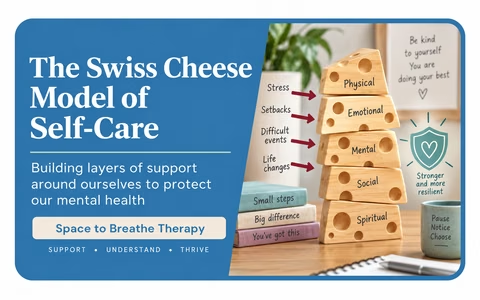
The Swiss Cheese Model of Self-Care
Building Layers of Support Around Ourselves
I really like the Swiss Cheese Model because it reminds us of something important:
None of us gets self-care right all of the time.
Imagine each area of your wellbeing as a slice of Swiss cheese. Every slice has holes. Our physical health might be going well while we're struggling emotionally. We may have supportive relationships but be exhausted and not sleeping properly.
No single layer can protect us from everything.
But when we build several different layers of support, the holes are less likely to line up.
That's where resilience can begin to grow.
Your Physical Layer
This includes things such as movement, sleep, food, hydration and rest.
It doesn't have to mean joining a gym, following the perfect diet or completely changing your lifestyle.
Sometimes physical self-care is:
Drinking some water.
Getting outside for ten minutes.
Having something to eat.
Stretching your body.
Going to bed a little earlier.
Allowing yourself to rest.
A tip from me
Don't underestimate the basics.
When life becomes overwhelming, we can sometimes look for complicated solutions while forgetting that our body may simply be telling us:
“I need looking after too.”
Your Emotional Layer
Our emotions need somewhere to go.
Self-care isn't pretending to be positive all the time.
It's being able to recognise:
I'm angry.
I'm overwhelmed.
I'm frightened.
I'm sad.
I'm exhausted.
without immediately judging ourselves for feeling that way.
A tip from me
Instead of asking:
“What's wrong with me?”
try:
“What's happening for me right now?”
That small change can move us from judgement towards curiosity and compassion.
Your Mental Layer
Our minds need breaks too.
Constant thinking, worrying, planning, problem-solving and processing can leave us mentally exhausted even when we haven't physically done very much.
Boundaries, breaks, reducing demands and giving your brain time to reset all belong in this layer.
A tip from me
You don't have to earn rest by reaching breaking point first.
Rest can be preventative, not just something we do once we've run out of energy.
Your Social Layer
Human connection can be incredibly protective.
That doesn't mean we all need large friendship groups or busy social lives.
For one person, connection might mean being surrounded by people.
For somebody else, it might mean one safe person, a message from a friend, time with family, a support group or simply knowing there is somebody they can contact.
A tip from me
Think about quality rather than quantity.
Ask yourself:
“Who can I be myself around?”
Those relationships are often the ones worth nurturing.
Your Meaning and Purpose Layer
This layer doesn't have to be religious or spiritual.
It can simply be about what gives your life meaning.
Your values.
Family.
Nature.
Creativity.
Helping others.
Learning.
Faith.
Animals.
Community.
Something you're working towards.
Anything that helps you reconnect with why things matter to you.
My Favourite Part of This Model
The holes are supposed to be there.
That's the part I want people to remember.
You aren't failing because one area of your life isn't going brilliantly.
Self-care isn't about creating a perfect life with no stress, difficult emotions or challenging days.
It's about recognising where your gaps are and gently asking:
“What layer might need a little more support today?”
Maybe today you need rest.
Tomorrow you might need connection.
Next week you may need stronger boundaries.
And sometimes you may need professional support.
All of those are valid.
A Little Check-In From Me
Take a moment and ask yourself:
How is my body?
How am I feeling emotionally?
Has my mind had enough rest?
Do I feel connected to somebody?
Is there something in my life that gives me meaning or purpose?
You don't need to fix every layer today.
Choose one small thing.
Because self-care doesn't have to be enormous to count.
Small steps. Lots of layers. Stronger support.
And remember: having holes doesn't mean you're doing anything wrong.
It simply means you're human.
Until next time, give yourself Space to Breathe.
Maggie
Space to Breathe Therapy