






























.jpg)
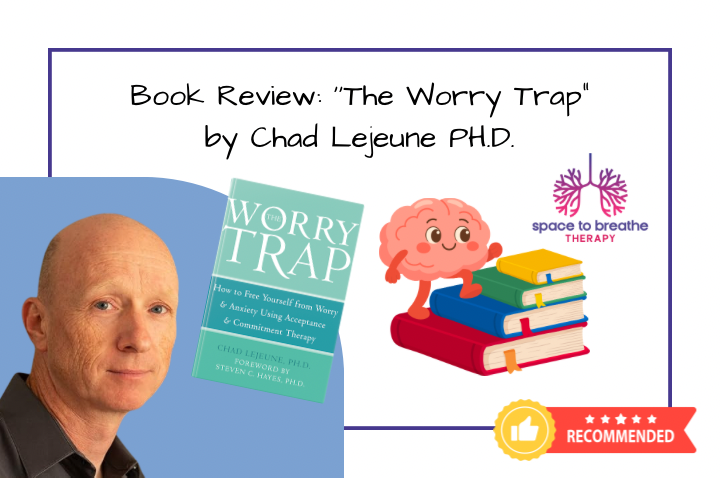
At the heart of The Worry Trap is a simple but powerful idea. Worry often feels useful or productive, yet it can quietly trap us in cycles of avoidance and exhaustion.
Rather than focusing only on reassurance or challenging thoughts, the book introduces principles from Acceptance and Commitment Therapy (ACT), including acceptance instead of control, stepping back from thoughts through cognitive defusion, acting in line with personal values, and developing psychological flexibility. The aim is not to eliminate worry completely, but to learn how to live well alongside it. That perspective immediately sets the book apart from more traditional approaches to anxiety.
Reading The Worry Trap by Chad LeJeune was both professionally interesting and personally validating. As a psychotherapist who is autistic and ADHD, with lived experience of anxiety, worry is something I understand from both a clinical and personal perspective. What the book offers is not simply a way to get rid of worry, but a different way of relating to it.
Early in the book, LeJeune explores the nature of worry and why many of our attempts to control it can end up making things worse. One of the central ideas is that worry is often the mind’s attempt to prepare for possible future threats rather than something that is actually happening in the present moment. As the book explains, worry is often a response to something that might happen, rather than something unfolding right now.
This idea resonated strongly with me. Many people who experience anxiety, particularly those of us who are neurodivergent, are very skilled at anticipating possibilities, risks, and outcomes. The mind can become highly attuned to scanning for problems. The difficulty is that when we try too hard to push those thoughts away or control them, the struggle itself can make the worry even louder.
The therapeutic framework used in the book is Acceptance and Commitment Therapy, which focuses on building psychological flexibility rather than trying to remove uncomfortable thoughts or feelings altogether. Instead of fighting anxiety, ACT encourages noticing thoughts, creating a little distance from them, and reconnecting with the present moment and the values that guide our lives.
One of the practical tools introduced in the book is the LLAMP model. This approach guides readers through a series of steps: labelling anxious thoughts, letting go of the struggle to control them, accepting and observing the experience, returning attention to the present moment, and then moving forward in a direction that aligns with personal values.
What stands out most about this approach, both as a therapist and as someone who has lived with anxiety, is the compassion behind it. The message is not that worry must disappear before we can live a meaningful life. Instead, the book suggests that life can continue to unfold fully even when worry shows up from time to time.
The Worry Trap reads less like a traditional self help manual and more like an invitation to shift the way we relate to our own minds. Rather than constantly wrestling with anxious thoughts, it encourages stepping back, noticing them, and continuing to move toward the things that matter most. That perspective can be incredibly freeing, especially for people who have spent years trying to fix or silence their anxious mind.
In many ways, the book reflects something often seen in therapeutic work. Freedom does not necessarily come from eliminating anxiety completely, but from learning that it can exist alongside us without dictating the direction of our lives.
With Love, Maggie.




