





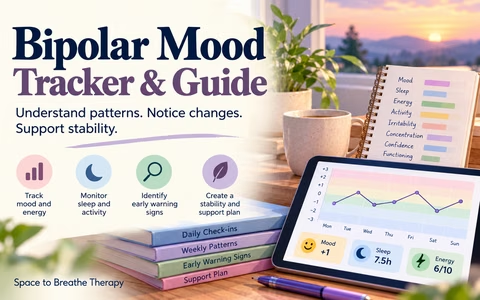
Bipolar Mood
Tracker & Guide
Understand your own patterns. Notice changes in mood, sleep, energy and everyday life. Build a support plan that makes sense for you.
My Personal Baseline
Understanding what is usual for you
Your baseline is personal
Everyone has different patterns. Your baseline is what your sleep, energy, mood, routines and functioning usually look like during a relatively settled period.
It is not an ideal you need to achieve. It is simply a useful reference for noticing change.
Daily Mood Check-in
A few moments to notice how today has been
Choose a date to record your observations.
🌈 How would you describe your mood?
This −3 to +3 scale is a personal tracking tool, not a diagnostic rating. The middle is your own settled baseline.
No mood value selected yet.
⚡ Energy & Activation
🌙 Sleep & Rest
Sleeping less and feeling exhausted can be different from needing less sleep without tiredness. Recording the difference may be useful.
🧠 Thoughts, Speech & Confidence
🧭 Impulsivity & Daily Functioning
♡ What would help today?
My Mood Patterns
Explore your last seven calendar days
Select a date beneath the chart to open its check-in. Gaps are left blank rather than assumed to be settled days.
🌙 Sleep across the week
Compare sleep with your own baseline rather than an arbitrary ideal.
🔍 Pattern Reflection
Add daily entries to begin seeing patterns.
My Early Warning Signs
Learn which changes are meaningful for you
↗ When my mood may be rising
Changes can include needing less sleep, increased activity, faster speech, irritability, unusual confidence or more impulsive decisions.
↘ When my mood may be falling
Changes can include withdrawal, reduced energy, difficulty concentrating, changes in sleep, hopelessness or struggling with daily tasks.
↕ When signs overlap
Some people experience agitation, irritability, racing thoughts or high energy alongside distress and low mood. Mixed symptoms may require prompt clinical attention.
👥 People who may notice changes
My Stability & Support Plan
Support that fits my own needs
🌿 What helps me stay settled?
📞 My support contacts
🧭 My response plan
💊 Medication & Treatment Safety
If you take prescribed medication for bipolar disorder, continue it as directed. Do not stop, restart or adjust doses without advice from the prescribing clinician.
Speak to your healthcare team about missed doses, side effects, medicine interactions, pregnancy planning or treatment concerns.
🆘 If support is needed now
If you feel at immediate risk, someone is in danger, or there are severe symptoms such as loss of contact with reality, call 999 or attend A&E.
For urgent mental health help in England that is not an immediate emergency, call NHS 111 and select the mental health option. You can also contact your existing crisis team.
For emotional support, Samaritans can be reached free on 116 123.
These UK contacts do not replace your own local or clinical crisis plan.
💌 A personal message from Maggie
Tracking your mood is not about judging your feelings or measuring how well you are doing. It is about getting to know your own patterns and recognising when something has begun to change.
One difficult day does not define you. One energetic day does not tell the whole story. What matters is the wider picture and understanding what helps you feel supported.
You do not have to notice every change perfectly, and you do not have to manage significant changes alone.
Space to Breathe Therapy




