





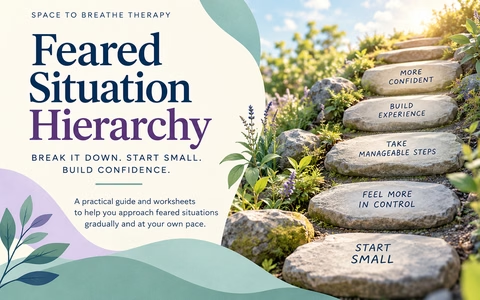
Feared Situation Hierarchy
Break it down. Start small. Build confidence. Read the guidance, create a personalised fear ladder and print exercises whenever you are ready.
Read the Guide
There is nothing to complete while reading. You can return to these pages whenever you need.
What is a feared situation hierarchy?
A fear hierarchy is an organised set of smaller steps towards an activity that matters to you. Avoiding a frightening but safe situation can bring immediate relief. Over time, however, repeated avoidance may make the situation harder to approach. Graded exposure offers a way to practise in manageable stages, rather than facing the hardest situation first.
What is SUDS?
SUDS stands for Subjective Units of Distress. Rate distress from 0 (none) to 100 (highest you can imagine). The score is personal. It is not a medical assessment, and it is not necessary for distress to fall to zero for the experience to offer learning.
Building ten steps
Start with an overall goal. Make each ladder step specific, including what you would do, where and with whom. Put the least demanding activities towards the beginning, but choose steps based on your own circumstances. You can add in-between steps, change the order or repeat a step.
Example: asking a question in a group
A ladder might begin with writing down a question, speaking it aloud alone, practising with a trusted person, then asking a question in a small supportive group. Later steps could involve a larger meeting. The goal is not to copy this example but to make your own steps realistically manageable.
Supports and safety behaviours
Appropriate support is encouraged: communication aids, disability adjustments, a trusted person, rest, and any agreed professional support. Do not remove essential supports. Some habits, such as repeated checking when no check is needed, may reinforce fear; consider these carefully rather than automatically trying to remove them.
Practising and learning
Before a chosen safe practice, write what you predict and your SUDS score. Afterwards, note what actually happened and your peak and final scores. Consider what surprised you, what support helped and what you might do differently next time. A practice can count as useful learning even when anxiety remains high.
When to slow down or seek help
Exposure is not appropriate for genuinely dangerous, abusive, non-consensual or medically unsafe situations. Do not use exposure to disregard discrimination, safeguarding concerns, essential medical precautions or accessibility needs. Trauma-related fear, obsessive-compulsive symptoms, severe distress and some eating disorder presentations may need specialist adaptation and supervision. Pause or seek professional help if a step is overwhelming.
A message from Maggie
You do not have to force your way to the top of the ladder. A smaller step, a repeated step or a considered pause can all be part of learning. Confidence may grow through experience, but the aim is understanding and flexibility, not proving that you are never afraid.
Space to Breathe Therapy
My Ten-Step Fear Ladder
Arrange steps from less demanding to more demanding. Each SUDS value is an estimated rating, not a target to achieve.
Exposure Practice Record
Record one objectively safe, manageable practice. Repeating or adapting a step is allowed.
Saved practice records
Progress, Learning & Adjustments
Printable Worksheets for Later
These pages are blank so visitors can print them now and complete them in their own time. Choose any page or print the entire pack.
Worksheet 1 · My Goal & Starting Point
Choose a meaningful, objectively safe situation. Break it into manageable parts without removing essential support.
What is my meaningful goal?
Why does this matter to me?
What supports, boundaries or adjustments do I need?
What would make a starting step manageable?
Worksheet 2 · My Ten-Step Fear Ladder
Write one specific, safe action in each row. Expected distress (SUDS) ranges from 0 to 100. The ladder is flexible and is not a race.
The first step I might choose is:
An extra smaller step I could add if needed:
Worksheet 3 · Exposure Practice Record
Use this for one chosen safe practice. Anxiety does not have to disappear for the experience to be useful.
What do I predict will happen?
What did I actually do and what happened?
What did I learn from prediction versus outcome?
What support or adjustment would help next time?
Worksheet 4 · Progress & Reflections
Notice learning, changes and the support that helped. Progress does not have to follow a straight line.
What have I approached, attempted or noticed?
What felt more difficult than I expected?
Which step could I repeat, divide or adapt?
My next chosen step — or my decision to pause:




